
Your Story, My Story: How Narrative 4 Builds Understanding
As one in five Americans report “serious loneliness” and social fragmentation divides our social media and neighborhoods, National Book Award–winning novelist Colum McCann is using stories to connect teens
By Siobhan Roberts
Jul 28, 2025
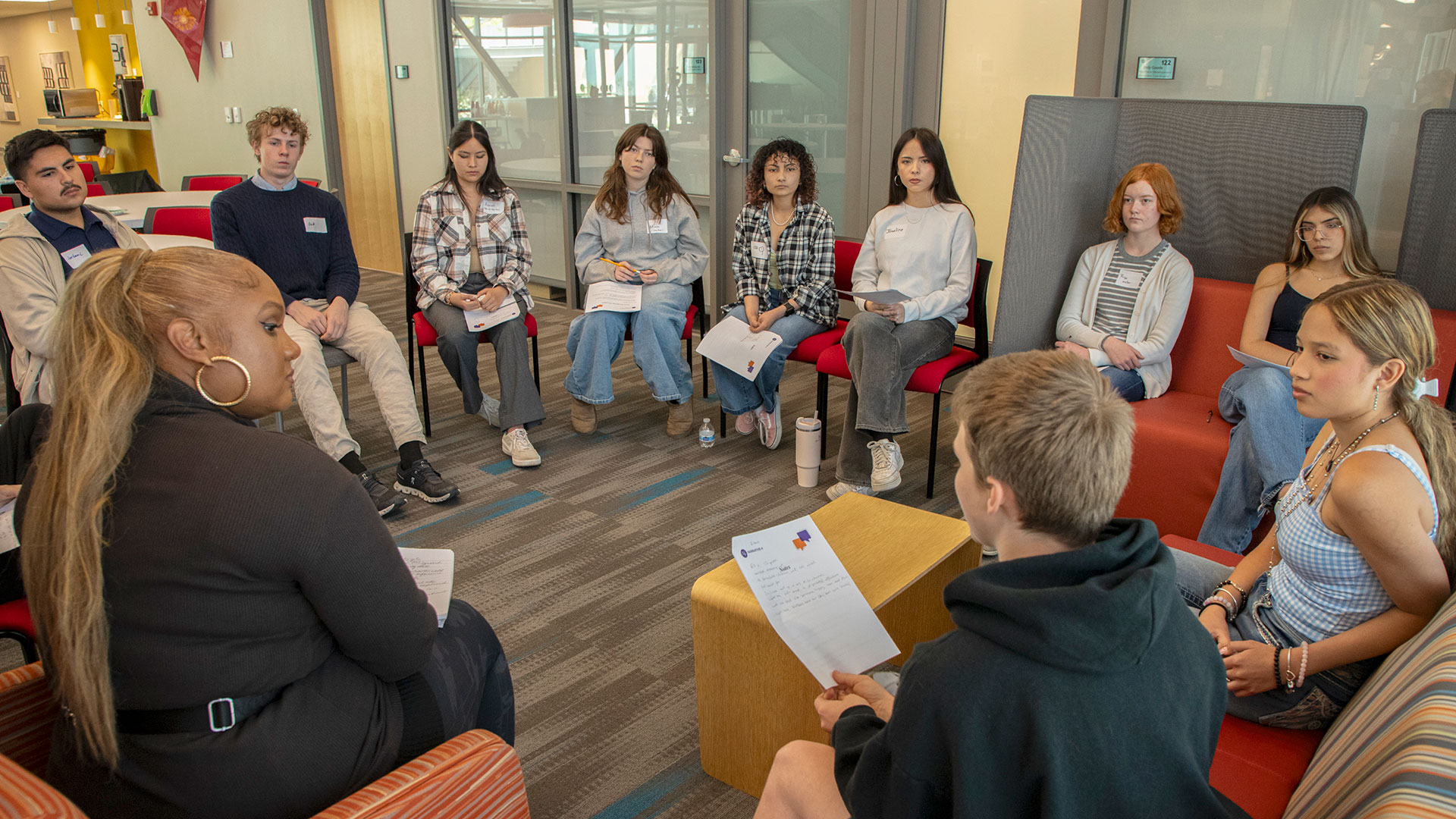
Recently, Araceli Madalena, an 11th grader at Santa Fe Indian School in Santa Fe, New Mexico, told a story she remembered from her childhood: She was about eight years old. She walked into a downtown art shop and saw something in a glass display case that she didn’t think should be there. It was a ceremonial wedding vase labeled “Pecos, 1883,” referring to one of her family’s tribes, Pecos Pueblo. It was unsettling, she recalled, to see this sacred heirloom on display and available for anyone to buy.
Madalena shared this experience as part of a story exchange. In return, Maya Harris, from nearby Santa Fe High School, shared a story about how a violinist had helped her overcome anxiety about playing the flute.
Harris and Madalena were among a group of some 50 students and teachers from four Santa Fe high schools taking part in a storytelling project organized by the global nonprofit Narrative 4, with support from Carnegie Corporation of New York. Founded in 2013 by National Book Award–winning novelist Colum McCann, the organization’s president, and CEO Lisa Consiglio, Narrative 4 uses the story exchange method to teach how sharing personal experiences leads to compassion and understanding. Consiglio devised the practice, based on a theater technique, to bring together strangers, typically high school and college students and educators of different backgrounds. It’s a process that encourages “a leap of radical empathy,” explains McCann.
"You tell my story, I tell yours. In the first-person. Face to face."
Colum McCann
The program responds to increasing fragmentation in our physical and digital worlds. A survey of 129 studies, published in April 2025 in the Journal of Computational Social Science found that network analyses demonstrate the existence of echo chambers on social media. Similarly, research by political scientist and 2025 Andrew Carnegie Fellow Jacob Brown shows that American neighborhoods are becoming more polarized, as increasing numbers of voters live with little exposure to neighbors who voted differently.
There is also evidence that Americans feel disconnected from each other. A 2024 Harvard report found that 21 percent of Americans report suffering “serious loneliness,” many of them describing disconnection from their friends, families, and communities. Loneliness, in turn, can feed polarization. A 2021 study by RAND Corporation, a Carnegie grantee, identified loneliness as a key contributor to extremist views and political radicalization.
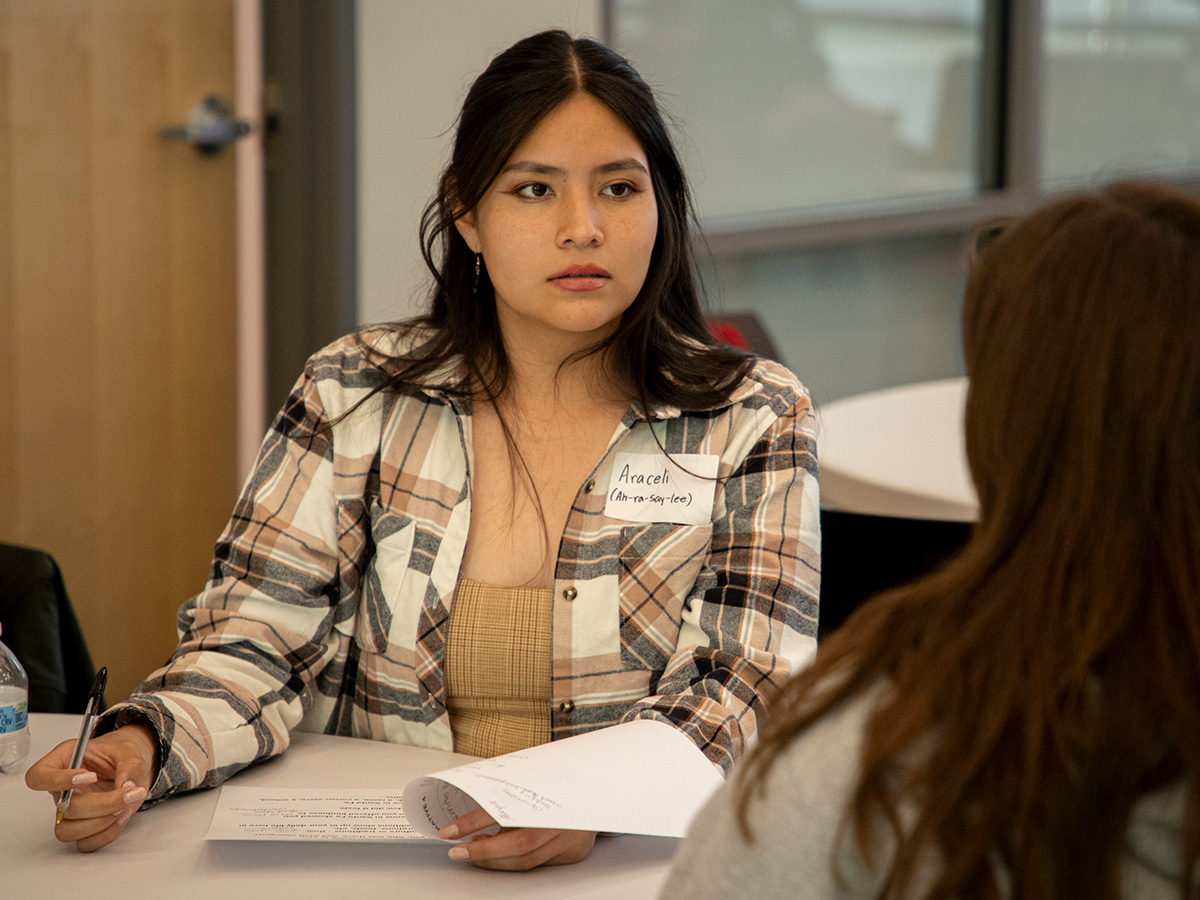
Araceli Madalena, an 11th-grader at Santa Fe Indian School in Santa Fe, New Mexico, participates in a Narrative 4 story exchange in April 2025. (Credit: Narrative 4)
One student observed that he expected it would be hard to use the first-person pronoun in telling his partner’s story, “but then halfway through I was thinking about it like it was my own story.”
Another commented, “It felt good to kind of experience someone as they experience themselves, and try to really put yourself into their shoes on a different level by saying that you are them.”
McCann’s favorite story-exchange prompt explores the notion of “repair.” For instance: “Tell a story about a time you repaired or restored something. It could be anything — a bicycle tire, a roof, a broken relationship, a family coming together, a shattering moment at work…”
One long-running Narrative 4 program has involved both in-person and online exchanges between students in grades nine through 12 from University Heights High School in South Bronx and Floyd Central High School in Eastern Kentucky.
McCann describes an exchange between a hijab-wearing young woman from the South Bronx and a pickup truck–driving, rifle-owning young man from Kentucky. He realizes that she’s wearing AirPods underneath her hijab and listening to Beyoncé’s country album, which he’s also been listening to. After sharing their stories, the two students worked together to organize a mental health fair at each of their high schools.
“I think one of the things that we’ve lost is the ability to understand the complexity or messiness or turbulence between us as a good thing,” McCann says. “We have these canals of certainty that people are inhabiting, and they do so because it’s easy to say you’re only one thing. But then when you realize that you’re so much more than one thing, that’s when a flourishing occurs.”
Narrative 4 is connecting young people across the country. Beyond Santa Fe, the organization is hosting story exchanges to build connections in Atlanta, Boise, Chattanooga, Denver, Milwaukee, New Haven, and New York City. It also recently launched an online platform to provide training for K–12 educators to become certified story-exchange facilitators.
In Santa Fe, the session ended with Madalena telling Harris, “I hope your music makes someone else feel the same way that the violinist made you feel.”
Harris replied, “I hope that you find beautiful ways to share your story and experiences with everyone.”
Against this backdrop, Narrative 4 believes it can build connection and understanding. “What we’re interested in, ultimately,” McCann says of the mission, “is that the stories lead to action, lead to change.”
The story-driven approach is backed by research. In a series of national studies, researchers at the MIT Center for Constructive Communication working with Cortico, a Carnegie grantee, found that people who shared statements of experience were consistently viewed as more empathetic, respectful, honest, and willing to listen. The study showed that “sharing stories can naturally lead to deeper understanding and reflection,” said Dimitra Dimitrakopoulou, the center’s head of translational research and a co-author of the study.
The Narrative 4 formula is simple. People pair off — with a partner they do not know — and swap a short story about their lives. “Not a didactic story, but a personal story,” McCann says. “Not something designed to win an argument, but something that stirs the soul.” Participants can draw on any seed of inspiration, but an event’s agenda provides the theme and offers a list of prompts.
Madalena was moved by the prompt: “Tell a story about your family’s culture or traditions … How do those traditions show up in your daily life here in Santa Fe?” After partners share stories, the exchange continues within the larger group. In this setting, partners flip the script — they tell each other’s stories. As McCann puts it, “You tell my story, I tell yours. In the first-person. Face to face.”
Siobhan Roberts is a regular contributor to The New York Times. Her latest book is Genius at Play: The Curious Mind of John Horton Conway (Princeton University Press).