
What If All U.S. Students Had to Pass the Citizenship Test to Graduate?
A national survey finds most Americans would fail. The Gilder Lehrman Institute aims to change that
By Wilfred Chan
Feb 4, 2026
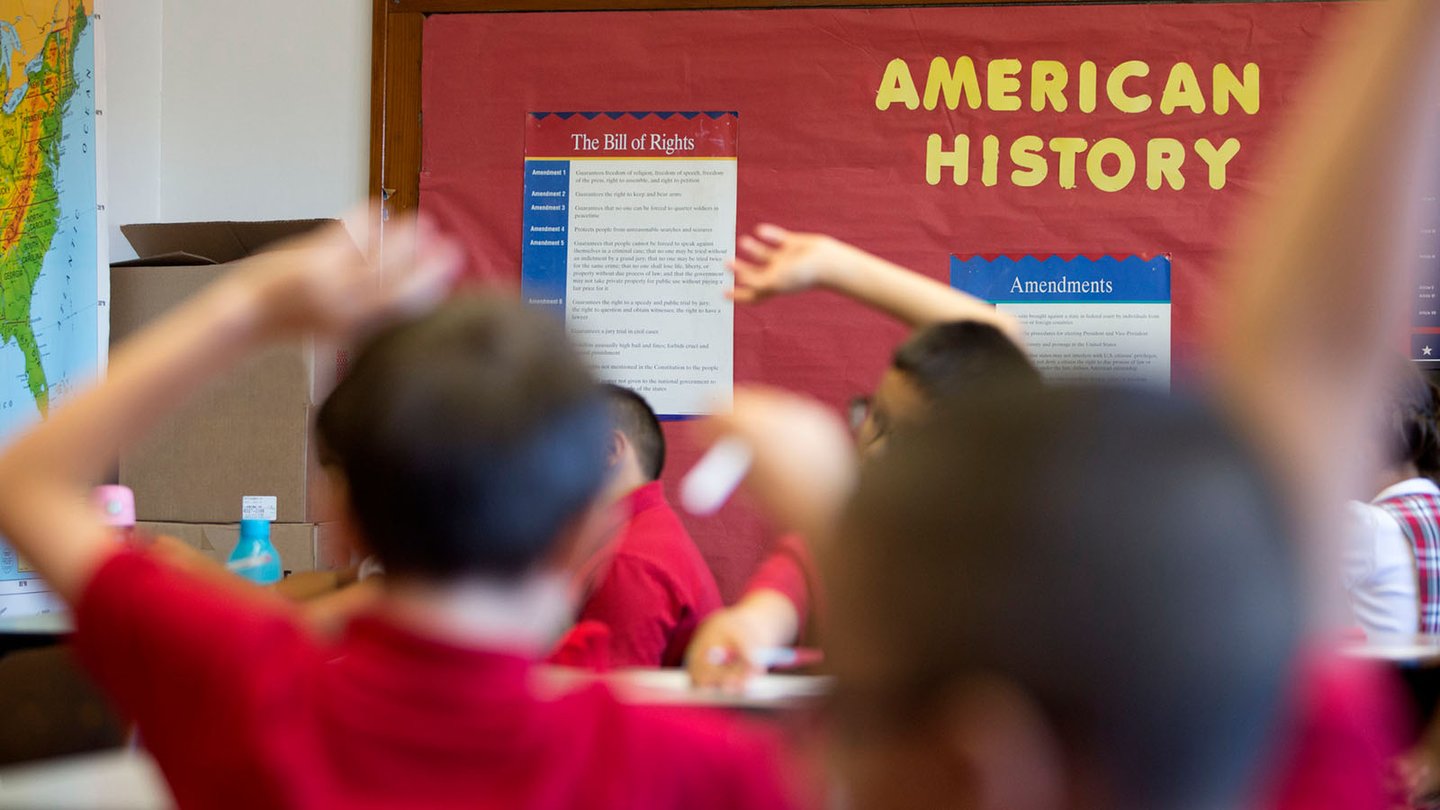
Picture a classroom full of high school students taking a 20-question pop quiz. The questions include: Why were the Federalist Papers important? Why did the United States enter the Persian Gulf War?
This isn’t the AP U.S. History exam. It’s the civics portion of the U.S. citizenship test taken by millions of immigrants every year as one of the final steps in the naturalization process. As civics knowledge among our country’s students dips to historic lows, the test has become a classroom tool and a cause for reflection about what every citizen ought to know.
Federal data show that around nine in 10 applicants for naturalization pass the civics test each year, which requires correctly answering 12 out of 20 questions, chosen at random from a list of 128. The general public would fare much worse. Fewer than one in five Americans under the age of 45 would pass the citizenship test, according to a 2018 survey by the Institute for Citizens & Scholars, a Carnegie grantee. That figure roughly mirrors the 22 percent of eighth graders ranked as proficient in civics in the 2022 National Assessment of Educational Progress, known as the Nation’s Report Card (the civics assessment is administered once every four years).
To understand the issue, journalist James Traub spent the 2023–2024 academic year touring public schools across the country, from Texas to Oklahoma to New York City, an experience he recounts in his book The Cradle of Citizenship. He observed that many schools seemed more comfortable with teaching civics skills like critical thinking than asking students to memorize historical facts. Traub thinks the two shouldn’t be separated. “Having a large stock of knowledge is indispensable for gaining the kind of civic understanding that we want citizens to have,” he says. “If newcomers have to demonstrate this knowledge, shouldn’t students, too?”
That’s why the nonprofit Gilder Lehrman Institute, a Carnegie grantee, is bringing the citizenship test into classrooms. In 2023, it launched K–12 educational resources based on the test, including practice tests and short videos from historians explaining the rationale behind the correct answers. So far, 93,000 unique visitors have taken Gilder Lehrman’s online version. The idea is to “have everyone take the exam to confirm your competence as a citizen,” says James Basker, the president of the organization and a professor at Barnard College. The test also gives students a chance to contemplate the meaning of citizenship, he says. “It raises the question of, what should we as citizens know?”
For much of the nation’s history, there was no uniform civics assessment for naturalization. The first U.S. naturalization law, enacted in 1790, introduced a requirement that applicants pledge an oath of allegiance to the Constitution, though it did not specify whether they should have to demonstrate their understanding of it. Instead, well into the 20th century, immigration examiners had discretion to quiz applicants as they saw fit, according to historian Jack Schneider.
"If newcomers have to demonstrate this knowledge, shouldn’t students, too?"
James Traub
Author of “The Cradle of Citizenship”
Amid Cold War fears in 1950, Congress added a requirement for applicants to demonstrate “a knowledge and understanding of the fundamentals of the history, and the principles and form of government, of the United States.” It wasn’t until 1986 that the U.S. Immigration and Naturalization Service established an official list of 100 questions for the test, many of them straightforward (“What are the colors of our flag?” “What is the White House?”). A 1997 congressional report criticized the test, noting that it relied on “memorization of discrete facts rather than on substantive understanding of the basic concepts of civic participation.” There were no changes until 2008, when the renamed U.S. Citizenship and Immigration Services replaced some of the simpler questions with more conceptual ones like “What is the rule of law?” It modified the test again in 2025 to add questions like “Why is the Electoral College important?,” bringing the total possible questions to 128.
Because the agency makes the questions and answers publicly available, the test can still be passed using rote memorization. That doesn’t diminish its educational value, says Gilder Lehrman’s Basker. The nonprofit holds an annual competition called the Citizenship Challenge, inviting students from grades 3 through 12 to submit an original question they believe should be added to the citizenship test. One finalist, a fifth grader, proposed “What is the Americans with Disabilities Act, and when was it passed?” explaining, “My friend has cerebral palsy, and he needs extra support to fully participate in school … The ADA is important because it makes sure no one is left out just because they have a disability.” Another finalist, a seventh grader, proposed, “What are you entitled to under the Fifth Amendment?” writing, “It is a cornerstone of our democracy that all citizens, but especially new ones, know their right to due process.”
In 2015, Arizona became the first state to require that high school students pass a civics test based on the citizenship test to graduate. As of 2025, there are 14 states with similar graduation requirements, according to data from CivXNow, a project of the nonprofit iCivics, a Carnegie grantee. Basker hopes that number can reach 50. “I like the idea that the test becomes a rite of passage for everybody,” he says. “It ratifies our common citizenship. It’s a way of demonstrating that we’re all in this together.”
Wilfred Chan is the senior content editor and writer at Carnegie Corporation of New York.