
Want Greater Prosperity? Mind the Gap
Why are the richest 20 percent of countries 30 times richer than the poorest? Three researchers have an answer, and it won them a Nobel Prize
By Aruna D’Souza
May 22, 2025

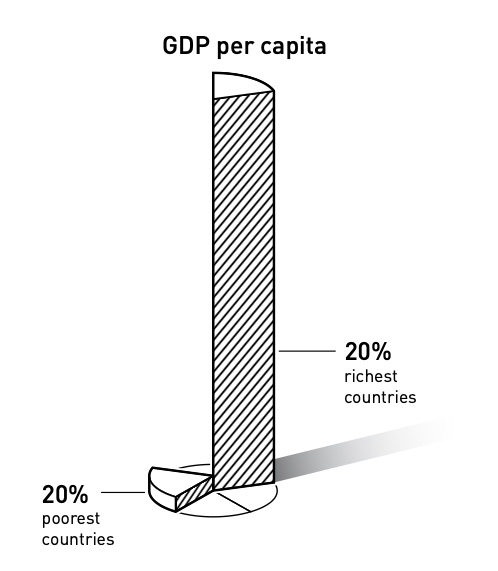
For the past 25 years, Daron Acemoglu, Simon Johnson, and James A. Robinson have worked — individually and collaboratively — on the question of why some nations are rich and others are poor. In 2024 they were awarded a Nobel Prize in Economics for their research on a question that has become increasingly pressing: why are the richest 20 percent of countries now 30 times richer than the poorest?
Reducing such inequity “is one of our time’s greatest challenges,” said Jan Teorell, a member of the economic sciences committee at the December 10 ceremony in Stockholm, where Acemoglu, Johnson, and Robinson were honored for their “studies of how institutions are formed and affect prosperity,” a theme that runs through their numerous papers and publications.
Pinning down the reasons for the persistence of such wealth disparities has occupied economists for a long time, including a number of previous Nobel Prize recipients. It’s a surprisingly knotty problem, because there are so many ways in which rich countries and poor countries differ. In the 1990s, many researchers turned to geographical factors such as climate, topography, disease, and availability of resources to explain economic disparities. “The fact that some people were interpreting this as a causal relationship struck Jim [Robinson] and myself as rather brazen,” Acemoglu said in his Nobel Prize lecture in December.
“Our contribution was to say, what’s behind those stories?” Johnson said in a recent conversation. “What’s the deeper cause, what are the historical roots of that discrepancy?”
At the heart of Acemoglu, Robinson, and Johnson’s work is their ability to show that the decisive factor is the type of political and economic institutions that exist in different sites — including public education, voting rights, market regulation, legal protection of property rights, and court systems that uphold those rights and rules — and whom they were built to serve.
Johnson searched for answers in an unusual place: archives recording the numbers of deaths of early European colonists in the years after their arrival in a new territory. He focused on data before 1850 — prior to the emergence of modern medicine and coinciding with the formative period of European colonial expansion. He was building on the research of Philip D. Curtin, the late historian of Africa and the Atlantic slave trade, especially his 1989 book Death by Migration: Europe’s Encounter with the Tropical World in the 19th Century, which focused on the mortality rates of English and French soldiers deployed in the tropics.
Based on colonial-era records, the laureates concluded that when colonists faced significantly higher mortality rates — because of disease, harsh climate, or violent resistance, say — they tended to set up institutions that served a fairly narrow set of interests. In places where the threat to colonists’ lives was less marked — and these include many settler-colonial states, such as the United States, Canada, and Australia, for example — colonizers tended to set up institutions that, over time, created more prosperity on average.
“In our work, what we’ve identified are these institutional and political differences between developed and underdeveloped countries, and the way in which there’s enormous differences in how inclusive the societies are in terms of the opportunities and incentives they give people,” said Robinson in an interview with the Nobel Foundation. “Our work is focused on trying to show how these different institutional structures create poverty or prosperity.”
Acemoglu traces his interest in the relationship between prosperity and politics to living through the consequences of Turkey’s military coup in 1980, which was triggered in part by the political instability caused by an economy on the verge of collapse, with triple-digit inflation, high unemployment, and a persistent trade deficit. He was in seventh grade at the time. Twelve years later, as a PhD student at the London School of Economics, he attended a talk by James Robinson, and over the course of the next few years, the scholars explored their shared interest in the historical roots of institutions and their long-term impact on economic outcomes.
In the late 1990s, now in the U.S. and teaching at MIT, Acemoglu met Simon Johnson, who had recently taken a position at the Sloan School of Management. The two began a conversation about colonialism and institutions. Acemoglu, Johnson, and Robinson published their first paper together in 2001, drawing together the different threads of their work and kicking off their prolific, decades-long collaboration.
Acemoglu and Robinson share a connection to Carnegie. Robinson was awarded a research grant for his Carnegie Scholar project “Understanding the Institutional Determinants of Comparative Development” in 2002. Acemoglu’s research received support from the foundation through an Andrew Carnegie Fellowship in 2017. The scholars’ first book together, Economic Origins of Dictatorship and Democracy, in 2005, built in part on Robinson’s Carnegie-supported research, sought to explain why democracies and dictatorships rise and fall, and demonstrated that such transitions between democratic and authoritarian regimes are deeply tied to who is allowed to prosper in a particular political formation.
In their 2012 book Why Nations Fail, Acemoglu and Robinson examine two towns named Nogales — one in Arizona and one just across the border in Mexico — which were almost identical in terms of geography, climate, and the demographic and cultural background of residents. Yet those residents experienced stark differences in income, lifespan, educational achievement, and other factors.
Acemoglu and Robinson proposed that the contrast could be accounted for by the fact that the Arizona town developed more inclusive institutions — systems designed to benefit the greatest number of people rather than just a small, powerful elite, that protected property rights, and that conferred democratic rights — whereas the Mexican town did not. In Nogales, Mexico, societal and political conditions made it less desirable, or even risky, to set up and run companies.
Why Nations Fail became a New York Times bestseller. In addition to publishing research articles in scholarly economics journals, the laureates are committed to writing more accessible books with the hopes of reaching the broader public, said Acemoglu.
A cornerstone of the Nobelists’ thinking is the role of democracy — which is characterized broadly by the existence of inclusive institutions which benefit a broad swath of people — in ensuring prosperity.
“Every prosperous country today, historically, was extractive,” said Robinson in his interview with the Nobel Foundation. “Think of the United States, you know, think of the history of slavery and the expropriation of indigenous people. And there was a struggle to create more inclusive institutions and a more inclusive society.”
Creating more inclusive institutions leads to a more inclusive society, but that transition is unlikely to come from the top, according to Robinson. “Inclusive institutions are not created by well-meaning elites,” Robinson said in the interview. “They’re created by people who fight for their rights and fight for a different vision of society.”
Robinson cited the civil rights movement as an example “of people getting organized collectively to fight for their rights, to fight against extractive economic and political institutions in the United States in the 1950s and 1960s.”
"Inclusive institutions are not created by well-meaning elites. They’re created by people who fight for their rights and fight for a different vision of society."
James A. Robinson

Acemoglu and Robinson address the importance of democracy, and its contemporary condition, in their 2019 book The Narrow Corridor: States, Societies, and the Fate of Liberty. “In The Narrow Corridor, we view the foundations of liberty and democracy to be quite fragile at the best of times — more so in the U.S. for a variety of reasons, going back to the early design choices that were made,” Acemoglu said.
Among the potential consequences of a democracy in decline, Johnson said, are economic ones. “The strength of democracy is that it gives many people the opportunity to invest in themselves and their families, in their communities, in their companies, and it protects them against arbitrary seizure or expropriation.” When the erosion of democratic institutions leads to political uncertainty and risk, he explained, the more likely adverse economic conditions will arise.
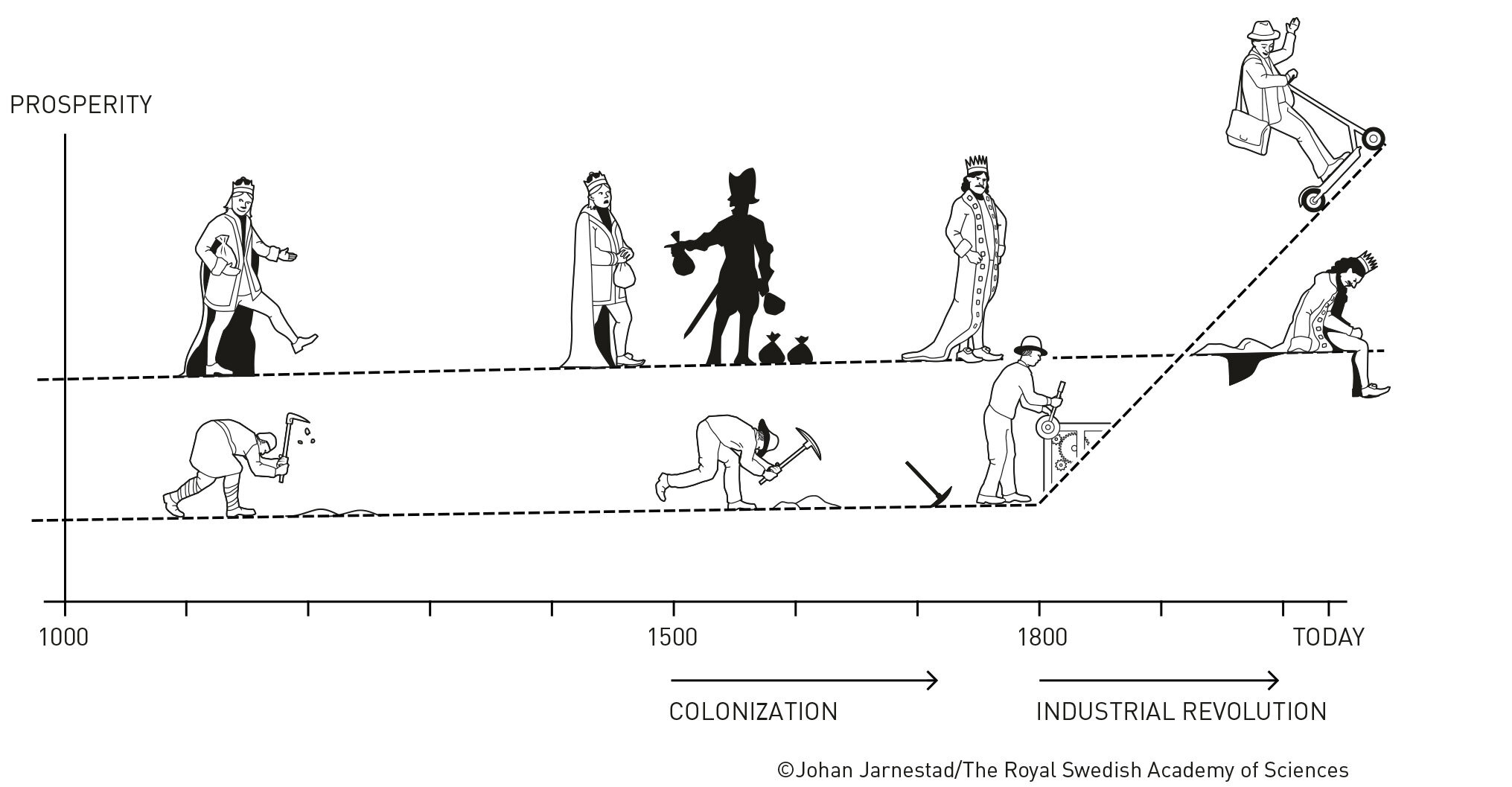
Acemoglu and Johnson’s work recently has taken on the thorny question of how technology fuels prosperity. In their 2023 book Power and Progress: Our Thousand-Year Struggle Over Technology and Prosperity, they challenge the idea that technological advancement inevitably leads to progress. Through case studies stretching back to the Middle Ages in Europe, they warn that new developments like artificial intelligence will only benefit society if they are used to build tools that empower the majority of people rather than enrich a few.
Acemoglu said that one of his next projects is a continuation of his work on AI, research he undertook while he was an Andrew Carnegie Fellow in 2017. Another, also connected to his Carnegie-supported research, will revisit his early book with Robinson, Economic Origins of Dictatorship and Democracy.
“I think democracy is in crisis, so it is a good time to think about what factors created this crisis,” Acemoglu explained. “Which aspects were inevitable, which aspects of it were due to different choices and mistakes that were made, and what is now possible. What can we do to revive democracy?”
While the laureates don’t underestimate the challenges today’s world poses for the development and sustenance of inclusive institutions, nor are they without optimism. “Institutions are always about choices,” said Acemoglu at the Nobel Prize ceremony. “What worries us also gives us hope. We can build better institutions and choose a direction for technology that creates more good jobs. But this has to be a collective effort.”
Aruna D’Souza writes on the role of institutions in shaping ideas about art, society, and culture. She is a regular contributor to The New York Times and 4Columns, and is the author of Whitewalling: Art, Race & Protest in 3 Acts and Imperfect Solidarities.
ABOUT THE LAUREATES:
Daron Acemoglu is Institute Professor of Economics at the Massachusetts Institute of Technology. He was an Andrew Carnegie Fellow in 2017.
Simon Johnson is the Ronald A. Kurtz (1954) Professor of Entrepreneurship at the MIT Sloan School of Management.
James A. Robinson is Institute Director of The Pearson Institute and Reverend Dr. Richard L. Pearson Professor and University Professor at the Harris School of Public Policy and Department of Political Science at the University of Chicago. He was a Carnegie Scholar in 2002.
FURTHER READING:
- Daron Acemoglu and James A. Robinson, Economic Origins of Dictatorship and Democracy (Cambridge University Press, 2005).
- Daron Acemoglu and James A. Robinson, Why Nations Fail: The Origins of Power, Prosperity, and Poverty (Crown Currency, 2012).
- Daron Acemoglu and James A. Robinson, The Narrow Corridor: States, Societies, and the Fate of Liberty (Penguin, 2019).
- Daron Acemoglu and Simon Johnson, Power and Progress: Our 1000-Year Struggle Over Technology and Prosperity (PublicAffairs, 2023).