
The Power Broker at 50
A Carnegie fellowship in 1967 provided time for Robert Caro to investigate how political power really works. His resulting book about Robert Moses won a Pulitzer Prize and is as relevant as ever
By Kelly Devine
Apr 8, 2025
In 1966 Robert Caro was working on his first book. A 31-year-old reporter at Newsday at the time, he had become intrigued by Robert Moses, who had never been elected to a public office but nonetheless wielded tremendous political power for 44 years, between 1924 and 1968, through the administrations of five mayors and six governors.
Caro and his wife didn’t have any savings so he couldn’t afford to quit his job, and trying to write the book as a full-time reporter wasn’t working. Then he heard about a fellowship that had been established by Carnegie Corporation of New York to provide the time, environment, and resources “for individuals with the capacity and motivation to undertake appraisals in depth of major problem areas in contemporary society.” The fellowship was a precursor to the establishment of the Andrew Carnegie Fellows Program in 2015, which to date has supported the research of almost 300 scholars in the humanities and social sciences.
Caro was awarded a Carnegie fellowship in 1967. When The Power Broker, weighing in at 1,286 pages (his original draft was more than a million words), was published in 1974, it was immediately heralded as groundbreaking. It went on to win the Pulitzer Prize for biography the following year and sell hundreds of thousands of copies. It is currently in its 74th printing.
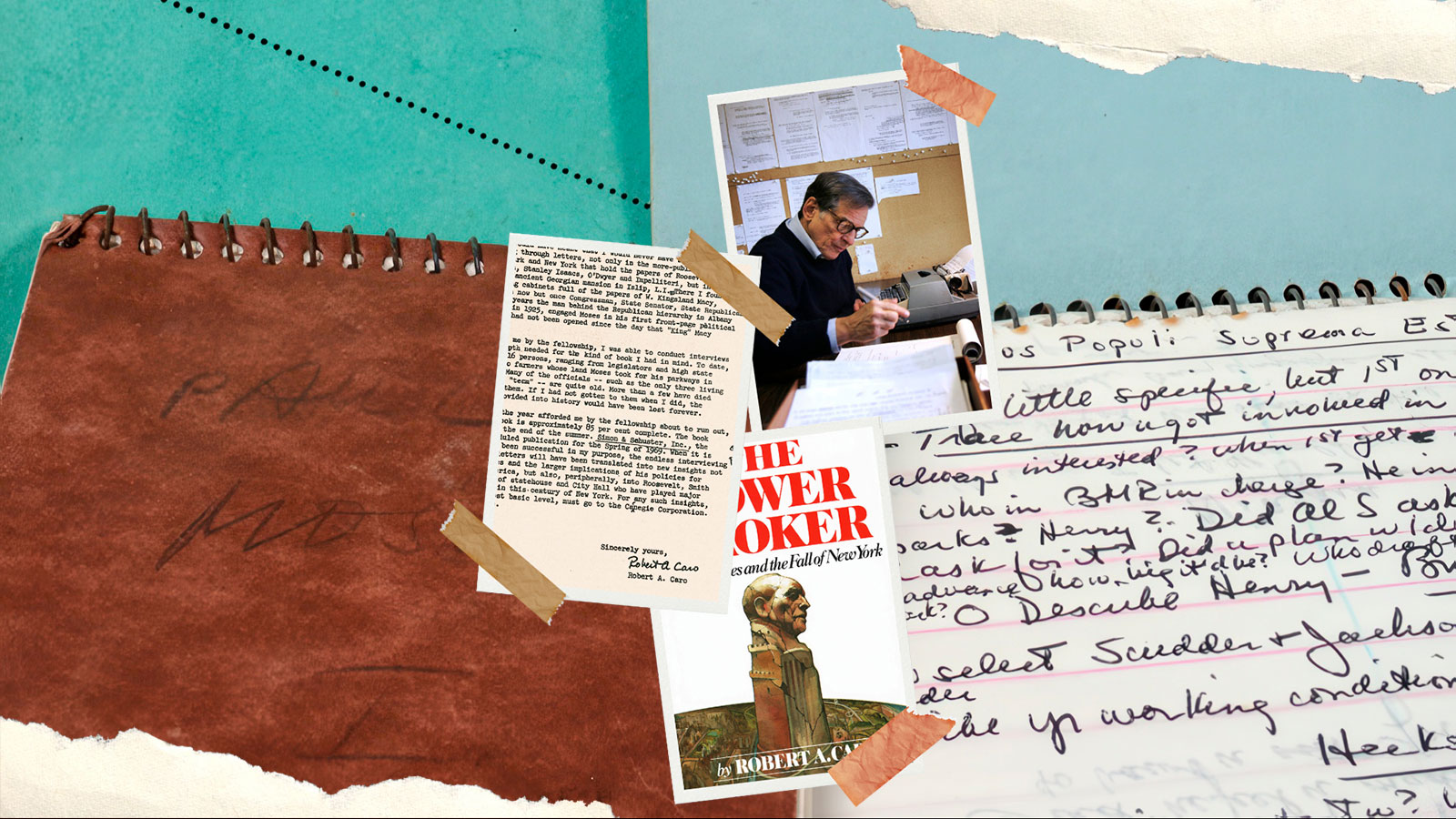
Fifty years after the publication of what The New York Times recently called a “revered classic,” the volume and its extraordinary influence are being celebrated with an exhibition, The Power Broker at 50, at the New York Historical Society (through August 3, 2025). Caro’s book reveals how an unelected city planner destroyed communities as he reshaped New York City –– more than half a million people lost their homes when Moses built expressways, like the Cross Bronx Expressway, through their neighborhoods. The exhibit features a selection of handwritten notes, photographs, and edited manuscript pages from Caro’s archives.
In 1968, at the conclusion of his Carnegie fellowship, Caro wrote to Professor Penn Kimball at the Columbia Graduate School of Journalism, underscoring the importance of the support for scholarly research and the impact that the Carnegie grant had on the development of The Power Broker.
The Carnegie fellowship, “enabled me to leave my job at Newsday and devote full time to the book. It gave me a salary, some badly needed secretarial help, a part of my expenses –– it gave me, in sum, time,” Caro wrote in his letter to Kimball, dated January 16, 1968. “And time is what is needed to do a book like the biography I had in mind.”
My interest is in political power and how it works. The U.S. is a democracy, so we the people are supposed to have the power. Therefore, the more we know about how political power really works, the better we can do — not just theoretically, but really.
Robert Caro
Carnegie Fellow and author of The Power Broker
Caro explained that Moses’s own files were closed, as they had been for the prior 43 years, to researchers. “To put together a picture of the man –– and of his monumental and largely unexplored influence on the future of New York State, New York City, and the urban politics of the entire nation –– requires vast amounts of digging in other collections of original source material,” Caro continued. “Such digging cannot be hurried.”
Often the most illuminating material is found in “very unpromising-looking files,” observed Caro. With the time allowed by the fellowship, Caro interviewed 416 persons, “ranging from legislators and high state and city officials to farmers whose land Moses took for his parkways in the 1920s and 30s. Many of the officials … are quite old. More than a few have died since I interviewed them. If I had not gotten to them when I did, the insight they have provided into history would have been lost forever.”
At the time his fellowship ended, Caro reported that his research on the book was approximately 85 percent complete. “If I have been successful in my purpose,” Caro wrote, “the endless interviewing and leafing through letters will have translated into new insights not only into Robert Moses and the larger implications of his policies for Twentieth Century America, but also, peripherally, into [Franklin D.] Roosevelt, [Alfred E.] Smith, and the other giants of statehouse and City Hall who have played major roles in the history in this century of New York.” Caro concluded: “For any such insights, the credit, at the most basic level, must go to the Carnegie Corporation. It made them possible.”
After The Power Broker, Caro turned from investigating urban political power to national political power. In June 2008, Caro visited Carnegie’s headquarters in New York City to celebrate the publication of The Passage of Power, the fourth book in his epic The Years of Lyndon Johnson. (He is currently working on the fifth and final volume.) “I’m not interested in telling the life of a great man. My interest is in political power and how it works,” Caro said at the time. “The U.S. is a democracy, so we the people are supposed to have the power. Therefore, the more we know about how political power really works, the better we can do –– not just theoretically, but really.”
Kelly Devine is principal director of content and dissemination at Carnegie Corporation of New York.