
Perceptions of Polarization in Local Communities Are Rising Sharply According to New Survey by CivicPulse/Carnegie
Forty-one percent of local government leaders say polarization is hurting their communities, up from 30 percent, and views of polarization nationwide remain high at 91 percent
New York, NY, October 6, 2026 —
Top-line takeaways:
- The 41 percent figure is the largest single-survey increase the series has recorded for polarization in local communities, an 11-point increase from a baseline that has held steady since 2024.
- Perceptions of polarization in smaller communities, under 50,000, show the first meaningful increase in the series, to 39 percent, though they remain less affected than larger communities (49 percent).
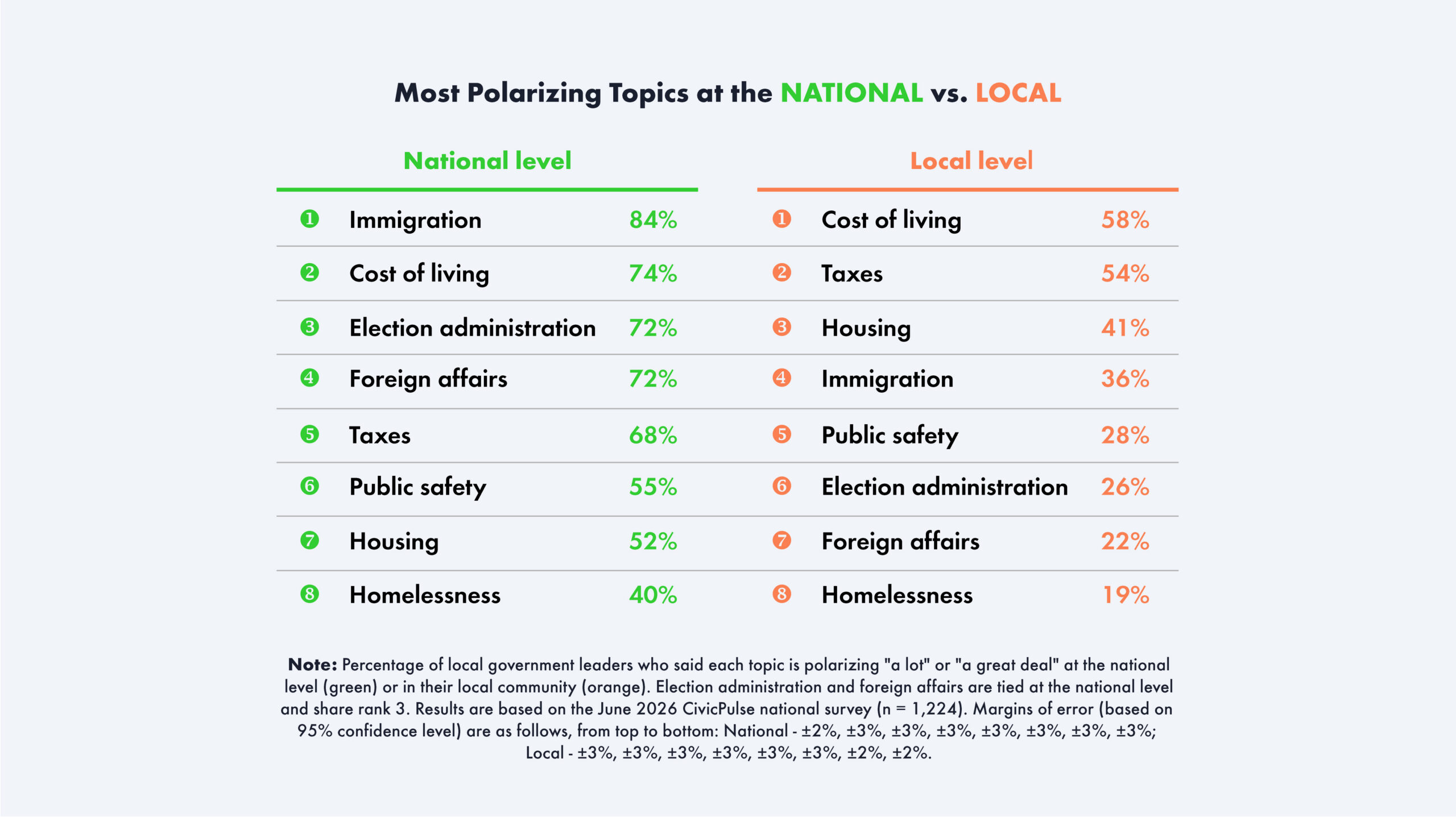
- Immigration is viewed as the most polarizing issue nationally; cost of living is the most polarizing issue locally.
- When asked what they are proud of, government leaders say residents showing up for one another across political lines, and school boards say staying focused on students despite divisions among members.
A new survey finds that 91 percent of local officials say polarization is negatively affecting the country, and in a sharp increase, 41 percent say that polarization is negatively affecting their own communities, up from 30 to 31 percent in previous surveys. This is the largest single change recorded in the survey results since data collection began in August 2024, and a departure from three prior surveys in which local communities were shown to be more insulated from polarization.
Among communities under 50,000 residents, the share of officials reporting substantial negative effects rose to 39 percent from a steady 28 percent. Larger communities, over 50,000, remain the most affected at 49 percent, up from a low of 40 percent.
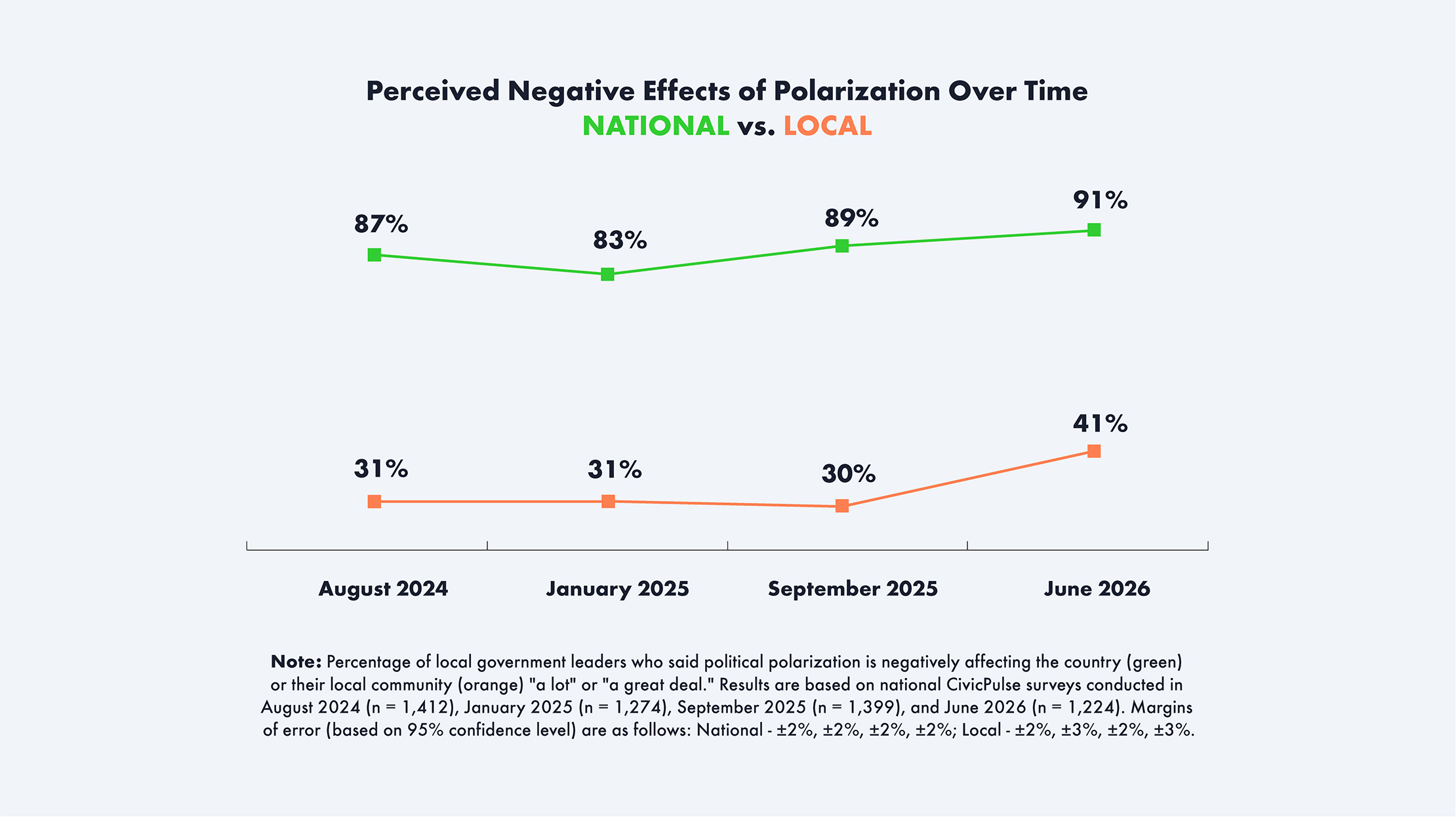
The Andrew Carnegie Foundation commissioned CivicPulse to conduct the ongoing series Polarization in America: Survey of Local Government to help inform the foundation’s grantmaking priority of reducing political polarization. The nationally representative surveys and interviews with municipal, county, and school board officials were conducted in August 2024, January 2025, September 2025, and June 2026.
“For three surveys, we have reported that local governments were largely insulated from national polarization. This survey shows that beginning to change and even reaching communities we described as the most resilient,” said James Kvaal, vice president, National Program, of the Andrew Carnegie Foundation. “It is a sober finding heading into the midterm elections, and it sharpens our focus on strengthening and sustaining local institutions where officials say common ground still holds.”
The issues that divide communities
For the first time, the survey asked officials to rate how polarizing specific issues are, both nationally and within their own communities. Nationally, immigration ranks first, cited as the most polarizing topic by 84 percent of officials, followed by cost of living (74 percent) and election administration and foreign affairs (both 72 percent). Within their own communities, cost of living leads at 58 percent, followed by taxes (54 percent) and housing (41 percent).
What to expect before the midterm elections
The survey also asked local leaders what they expect heading into the midterm elections in November. Two-thirds say cost of living (64 percent) and taxes (59 percent) are becoming more polarizing, followed by immigration at nearly half (44 percent).
More than two-thirds of local leaders (69 percent) expect polarization in their communities to worsen at least “a moderate amount” in the lead-up to the midterms, and 38 percent expect it to worsen “a lot” or “a great deal.”
Where resilience is strongest
Asked what they are proud of in their own communities, county and municipal officials most often cite community solidarity (32 percent), with residents coming together across political lines, followed by avoiding party labels (20 percent) and civil discourse and tangible accomplishments (19 percent each). School board officials most often cite keeping decisions centered on students (35 percent), followed by academic achievement and program quality (21 percent) and community support for schools (18 percent).
“Previously, local communities looked steadier than the country as a whole,” said Nathan Lee, founder and managing director of CivicPulse. “This survey shows us the first clear break from that pattern, especially in smaller communities, giving local leaders early warning of where pressure is building. The encouraging part is that officials still find their firmest common ground on the issues they most directly control, like public safety and homelessness.”
The most recent survey was conducted between June 23 and August 21, 2026, and surveyed 1,224 officials in local government, including members of city councils, county commissions, and school boards.
Read and download the full report: Download Survey IV
Read and download previous reports in the series:
Selection of responses from local government leaders:
The comments below are drawn from open-ended survey responses. Officials are identified by title and location only.
- “Polarization in national politics is making people angry and mean at the local level. Locals have started to attend local council meetings to say very unpleasant things to council members and other residents. This has never happened before this year.” — Mayor, small city, California
- “Our local council tends to stay clear of the national issues. Local issues tend to be less divisive and easier to find common ground. State and national are on a whole other level of divisiveness and vitriol — which means working for the people is harder.” — Council member, midsize city, Washington
- “[Our town] is largely insulated from outside politics on a national level. The only exception to that is its impact on federal funding for schools.” — School board president, small district, Alaska
- “The increase in cost of living is very concerning for our rural community. We have an added impact of being a tourist destination, which made the taxes go up as all the housing is getting bought up by rental companies and our kids can’t afford to live here.” — Chairman, board of trustees, small township, Ohio
- “Beyond the loud voices, there is an undercurrent of people feeling less able to afford the basics with the current economy and taxes and fear of losing their housing or having others in the community lose their housing.” — School board member, midsize district, Massachusetts
- “The main polarization is regarding property taxes, and the two sides are becoming less Dem v. Rep and more local v. state government.” — Council member, small city, Iowa
- “Our students are afraid of ICE arresting their parents. Parents are afraid to come to the school for meetings and events.” — School board member, small district, New Jersey
- “The issues brought on by the midterm elections percolate to people’s everyday conversations. This shapes their view of local governance and the community. National or state issues become assigned to local governance, even when the issue is not in the purview of local governance.” — Trustee, midsize municipality, Illinois
- “Residents can coalesce around local issues, such as tackling food insecurity, regardless of the polarization. The residents voted to triple the food pantry budget and continue to support projects that better the community in the long term.” — Selectman, small town, Maine
- “The first question we ask on every issue is, ‘How does this benefit our students?’ It keeps the discussion focused where it needs to be and centers our work on the main objective — educating students.” — School board member, midsize district, Virginia
About CivicPulse
CivicPulse is a nonprofit, nonpartisan research organization dedicated to enhancing local and state government in the U.S. by conducting representative surveys of public officials, producing actionable research, and facilitating practitioner-researcher dialogue.
About the Andrew Carnegie Foundation
The Andrew Carnegie Foundation, formerly Carnegie Corporation of New York, works to reduce political polarization through grants that support ladders of opportunity and a more peaceful world. Its funding provides individuals with the knowledge and tools needed to improve their lives, participate fully in society, and advance peace. Learn more at carnegie.org.
Contact CivicPulse for more on the data, demographics, and survey methodology: info@civicpulse.org