
‘Nothing is Unfixable’: Governor Thomas H. Kean on Division, Bipartisanship, and Philanthropy
The former New Jersey governor and longtime Carnegie board chair discusses political polarization and why compromise is not a dirty word
By Thomas H. Kean & Lionel Barber
Mar 17, 2025
Governor Thomas H. Kean embodies great American leadership. A former history teacher who became one of New Jersey’s most beloved governors, he won support from Republicans and Democrats to enact education reforms that were replicated across the country. He brought his faith in bipartisanship to lead the 9/11 Commission, whose unanimous 9/11 Commission Report led to the largest intelligence reforms in the nation’s history.
I was lucky to witness his influence up close as a trustee on the board of Carnegie Corporation of New York, where he served for three decades — 22 of those as chair. He was a master of the light touch. When he spoke, everyone snapped to attention. His gentle humor headed off trouble, early. If forces engaged, he quickly identified the middle ground. As the United States grew increasingly polarized, his thoughtful guidance of our board became ever more crucial.
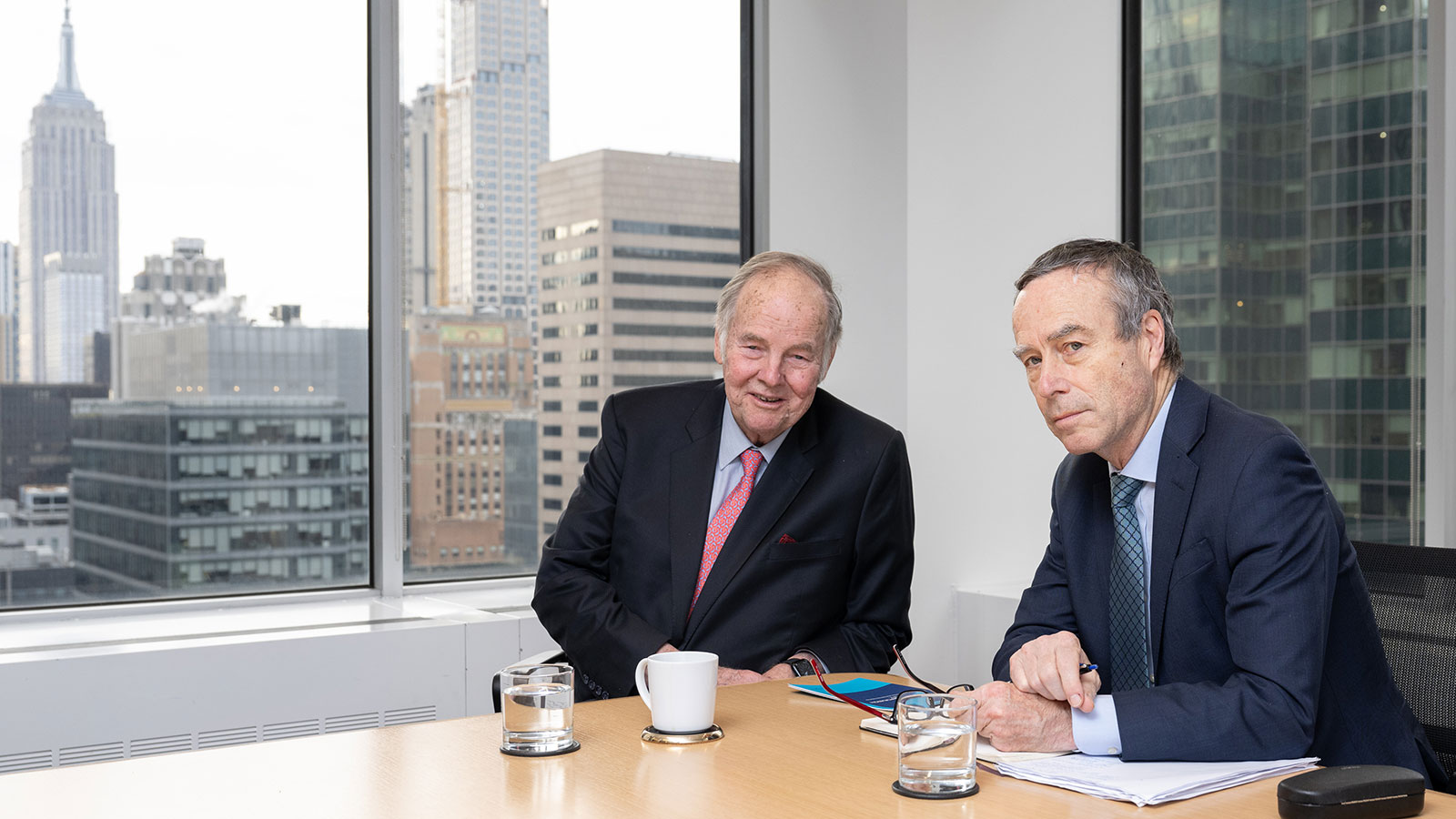
Governor Kean stepped down from his role as chairman in 2024. I had the privilege of catching up with him at Carnegie’s offices recently to reflect upon his years of service, why he still believes in political compromise, and where he thinks America is headed from here.
Lionel Barber: At its most basic, the purpose of philanthropy is to advance the common good. But today the common good is not so obvious, and this is proving deeply divisive. How to deal with this?
THOMAS H. KEAN: Division can be productive in a democracy, but not to the extent we have it today. We’ve got to look at that divisiveness, look at its roots, and see if there’s any way society can deal with it.
In my lifetime, the things that I’m most proud of were the result of compromises, like leading the New Jersey Assembly and the 9/11 Commission. In the end, there were always good people coming together to come up with a solution that everybody could accept.
On the 9/11 Commission, crucially, you made it a precondition that it was bipartisan.
Yes. We had 10 people: five Democrats, five Republicans, appointed by the most political people in Washington. When I first arrived, they were sitting separately, in Republican and Democratic caucuses.
The first thing I did was refuse to lead the Republican caucus, so it stopped. And a funny thing happened, when the Republican caucus hadn’t met for two or three weeks, the Democrats looked at each other and said, “Well, why are we doing this?” And they stopped as well. In public as well as in our private meetings, I made sure every Republican sat next to a Democrat, and this was just one of the things that started to lead toward a bipartisan consensus.
There’s a wonderful book by Bernard Crick called In Defence of Politics — I remember reading [it] as a student at Oxford many years ago — which argues that politics and compromise are necessary to solve problems without resorting to force. But now compromise has become a dirty word.
Well, I’ve done it all my life. I used to teach history — that was my first job. What I remind people is that without compromise, there wouldn’t be a United States of America. The so-called New Jersey Plan helped resolve differences over the representation of small states and large states. That compromise helped create the longest-lasting democracy in the world.
When I was in the New Jersey legislature, I was the lucky Speaker of the House where there was no majority by either party. The first thing I did is say, “I’m not going to accept any bill for passage without a Republican and a Democratic sponsor.” It became one of the most productive legislatures I ever served in, and when the speakership was up for reelection, both parties reelected me unanimously.
When I was governor, I never had a senate of my own party, and yet, they never blocked a major appointment. We worked on bills together, and when we got them through, I praised the sponsors in the Democratic Party, and then we got along. We’re still friends.
Do you think it’s possible for Carnegie to help rebuild the center in American politics?
It’d be a wonderful thing for Carnegie to take on. Without people able to see both sides of the issue, you never get important issues resolved.
I’ve never seen America so divided, and I’m just about old enough to remember 1968, the assassination of Martin Luther King, and the tremendous turmoil then. But it feels today as if the challenges are even bigger because of the depth of inequality, technological change, and also far greater diversity.
I had dinner the other night with the historian Doris Kearns Goodwin. What she said to me is: we’ve had some terrible problems in this country, but after we’ve come through the other side, we’ve ended up better. We ended up better after the Civil War. We ended up better after the Gilded Age, we ended up better after the Depression, we ended up better at the end of the Vietnam War. Each of those things she mentioned was troubling to the country at that time — but our history is that we muddle through and emerge on the other side better, not worse. Hopefully, this will happen again.
You’ve seen so much over three decades at Carnegie. Have your views on philanthropy’s role changed over that time?
Older foundations like Carnegie may have changed the way we do things, but we haven’t changed our mission. What Andrew Carnegie set up for us, the issues that he asked us to address — they’re just as relevant today, and that’s what we’re still doing.
I think philanthropy has got to take chances. Philanthropy is really risk capital, in some ways. For Carnegie, this is money that has been given by a benefactor who’s not here anymore. And so it’s money we should use in ways that perhaps no other organization would use it. To solve great problems, we have to take some risks.
Perhaps we should turn to Andrew Carnegie himself: every time I go on a cycling trip in the north of England or in Scotland, I come across one of his libraries. What do you think he can tell us about tackling today’s problems?
Andrew Carnegie understood the importance of education. He was from the poorest of the poor in Scotland, and when he was a small boy, he basically taught himself in libraries. He understood that without that education, his future would’ve been limited. Today, that’s probably even more true. If there’s one thing that frustrates me, it’s that the problems in education we were talking about on the first day I joined the board, still haven’t been solved.
What insights have you gained about grantmaking?
Even the best foundations, including Carnegie, make mistakes. Not all your grantees work out — and if you take chances, they shouldn’t. But you’ve got to recognize when that happens.
One of the things I tried to do was look at all grantees as if they were new. If you don’t do that, you can get attached to particular grantees and fund them year after year, forever. Then you’ve closed your doors to new grantees because your money’s spent.
You have to be open to the grant you don’t expect. Every now and then, it’s a remarkable grant, somebody you shouldn’t ignore.
Is there work that you’re especially proud of?
At Carnegie, we were talking about the importance of preschool education long before anybody else. And because of what we did, this country now understands that early childhood education is essential.
You’ve looked at the world, you’ve looked at the work of Carnegie. You remain an optimist.
I’m by nature an optimist, I think. There are a lot of things that look to be almost unfixable, but if you look at history, nothing’s unfixable.
Thomas H. Kean is an honorary trustee and former chair of the board of trustees of Carnegie Corporation of New York. He served as governor of New Jersey for two terms from 1982 to 1990. He also chaired the National Commission on Terrorist Attacks Upon the United States, known as the 9/11 Commission, which was responsible for investigating the causes of the September 11 attacks and providing recommendations to prevent further terrorist attacks.
Lionel Barber is a former trustee of Carnegie Corporation of New York. He served as editor of the Financial Times from 2005 to 2020. During his editorship, Barber led the digital transformation of the FT, winning multiple prizes for its journalism, including three Newspaper of the Year awards. His latest book is Gambling Man, a biography of Masayoshi Son. He has lectured on issues such as foreign policy, transatlantic relations, and monetary policy.