
Welcome to the U.S.
A rural Iowa town came together to provide homes and jobs to Ukrainian refugees. Will they be able to keep the community they’ve created?
By Siobhan Roberts
May 23, 2025

Every Sunday in DeWitt, Iowa, Yana Mamadaliieva and her family, refugees from Ukraine, attend mass at St. Joseph Church, sitting with fellow Ukrainians and newfound Iowan friends in pews at the back left of the nave. This out-of-the-way spot was originally chosen so they could converse during the service — without disturbing others — about the side-by-side English-Ukrainian text for the order of mass, printed out by an Iowan member of the congregation.
The Mamadaliievi family came to DeWitt in 2023, emigrating from Kryvyi Rih as they fled the Russia-Ukraine war. They are among some 22 Ukrainian families who, over the past couple of years, have settled in DeWitt. Nataliia Matiitsiv, with her husband and three children, made the journey last October from a small city near Lviv in western Ukraine. “Our whole life was in five suitcases,” said Matiitsiv. “When we arrive here, there is a new light for us. The people here are like angels.”
DeWitt — town motto “Crossroads to Opportunity” — is a small farm community, population 5,500. Located in Clinton County, it is about 25 miles west of the Illinois border along the Mississippi River. Politically, it leans conservative: President Trump received nearly 59 percent of the vote in Clinton County, where just around one in every 50 of residents is foreign-born. Residents here have welcomed their new neighbors, joining communities across the country in an effort that could now be at risk.
Many Ukrainians who have found their way to the United States arrived via Uniting for Ukraine, a Biden-era humanitarian parole program under which those fleeing the war could resettle here with the support of an American sponsor. Those families and their sponsors were in turn supported by Welcome.US, a national nonprofit funded in part by Carnegie Corporation of New York.
Welcome.US was launched in 2021 by former Obama and Bush administration officials to help Afghan refugees following the U.S. withdrawal from Afghanistan. It has been expanded to support sponsors and newcomers from countries including Cuba, Haiti, Nicaragua, Venezuela, and Ukraine. The initiative has contributed to the mobilization of an estimated two million sponsors in 12,000 zip codes and all 50 states — supporting nearly 800,000 newcomers, including many of the 280,000 who have arrived from Ukraine.
Anya McMurray, the president of Welcome.US, said the organization “taps into the desire of Americans and American institutions to live up to our shared values.” Immigration shouldn’t be framed as a “crisis that’s happening to us,” she added, but “an opportunity to be part of the solution, heal our divides, and ensure that America remains a land of opportunity.”
In January, the Trump administration ended the refugee program for Cubans, Haitians, Nicaraguans, and Venezuelans, and paused Uniting for Ukraine — leaving Ukrainians in DeWitt and across the United States unsure of their future.
‘A sense of belonging’
In the Midwest, the Iowa Newcomer Integration Community and Exchange (IA NICE), has helped welcome 76 Ukrainians. A nonprofit, IA NICE was launched in 2022 by DeWitt resident Angela Boelens with support from the Welcome.US network; this year Welcome.US gave IA NICE a small, one-time grant. The leadership of IA NICE is equally Democrat and Republican, according to Boelens, though its volunteers, donors, and contributors are predominantly Republican.
Boelens, a business administration instructor at Augustana College, became a sponsor soon after Russia invaded Ukraine in February 2022. Her great-grandmother arrived in the United States during World War II, pregnant, speaking only Polish, and soon thereafter a widow. “An Italian family in South Chicago was there to help her and took her in,” said Boelens. Only recently did Boelens learn that she has some Ukrainian ancestry.
Soon after sponsoring one family, whom she met via Welcome.US’s online platform, a second family asked for sponsorship, and she agreed. Boelens had an empty house with two kitchens where the newcomers could live. Then came requests from a third family, and a fourth.
Boelens asked a friend, a local banking executive, about other empty houses in town. In a matter of days he raised money through an investors group to purchase two houses for use by refugees as transitional housing. Boelens launched the nonprofit, and from there, community momentum grew. The local hospital system donated two transitional houses; another businessman lent one house.
Over time, IA NICE developed a successful model for helping refugees integrate into DeWitt. The newcomers arrive to a fully furnished temporary house, a stocked fridge, and a loaner car. Volunteers help them do paperwork, navigate health care, and enroll in the school system.

Sharon Roling, the principal at St. Joseph, a Catholic school with 180 students from preschool to eighth grade, hoped the school could be a “safe haven for the children.” Their decision to help, she said, is rooted in the Catholic Social Teaching principles: respecting the dignity of individuals; standing in solidarity.
Four Ukrainian boys from two families joined the school; the first time Roling heard them laugh, she thought to herself, “Ok, this is a good sign — it means they are starting to feel a sense of belonging here.” Google Translate came in handy, as did the school’s buddy system — and now the two older Ukrainian students are big buddies looking out for younger Iowan students.
Newcomers typically achieve self-sufficiency in three months without relying on state or federal refugee benefits. IA NICE volunteers are pragmatic, helping the newcomers get the qualifications — such as English language skills — and accreditations necessary for employment. “We get them jobs,” said Boelens.
At the local library, IA NICE holds English lessons for the Ukrainians, who also learn through online courses, apps, books, or tutors. Yana Mamadaliieva, an esthetician and tattoo artist, acquired two licenses in the United States, one for esthetic procedures, the other for permanent makeup. While studying, she put stickers scribbled with terminology all over her house, on the walls, furniture, mirrors, appliances, like vocabulary flashcards. In January 2025, she opened her own business, Yana Beauty, and rents an office at Salon Elle on 6th Avenue in DeWitt. Her husband, Anar Mamadaliyev, worked jobs at Ukrainian oil and compound feed factories, on construction sites, and on ships. In the U.S., he studied for his commercial driver’s license and now works for Wendling Quarries, a mining company.
“This has been an organic effort by our community, and it’s been driven by the heart. It’s the right thing to do for Ukrainians.”
Angela Boelens
Another newcomer, Iryna Hzyhko, had been a realtor in Kyiv. In DeWitt, she worked for a time cleaning houses. Then she studied to become a certified nursing assistant, but she needed to score 70 percent on the written portion of the exam to pass — a significant challenge. She received tutoring from Karen McWilliams, a retired registered nurse who serves on the IA NICE board and also helps the Ukrainians get doctor’s appointments — the local clinic where McWilliams had worked for 27 years agreed to provide services to the refugees as they arrived.
Living just a couple of blocks apart, McWilliams and Hzyhko met frequently to discuss words and phrases and their meaning. All the hard work paid off: Hzyhko passed the exam and landed a job at a nursing home. McWilliams said she focused on giving Hyzhko confidence and reassuring her that she was learning English correctly, “because it is a difficult language to learn.” Now, Hyzhko also serves on IA NICE’s board of directors.
As Boelens began building support for IA NICE, speaking to large groups in town — such as the Lions Club and the Rotary Club — she at times met skepticism. “There were some raised eyebrows,” she recalled. “Just the words ‘immigrant’ and ‘refugee’ struck a nerve or fear in some people. But we made a really, really deliberate effort to educate people. And very early on, once they understood who the Ukrainians were and got to know them, it was just kind of across-the-board, unanimous, widespread acceptance and welcoming.”
When Donald Thiltgen, who served as Dewitt’s mayor from 2000 to 2021, heard about the Ukrainians’ arrival, he invited three families to a barbecue. This was the beginning of a close friendship — now they gather not only for barbecues but also birthday parties and holidays. Two of the Ukrainian women volunteered to help maintain his large garden in the country. Together they gardened and canned vegetables, and shared recipes and customs.
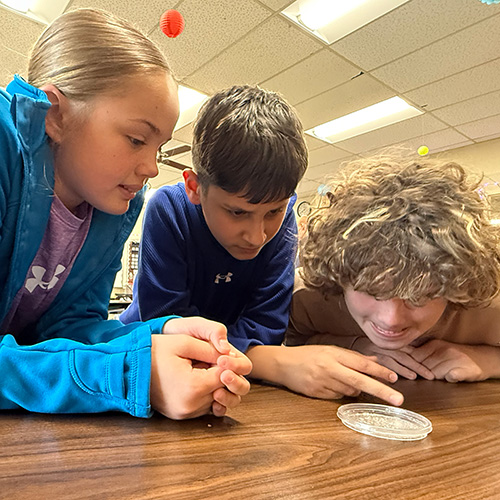
Yana and Anar Mamadaliyev’s son (middle) worked with fellow students at St. Joseph School, observing crystals they created using salt and water in their fifth-grade science class. Credit: Beth Gravert
‘Remain calm and supportive’
Faith is a big part of the DeWitt community: most IA NICE volunteers and donors belong to a church, whether Catholic or Methodist or Baptist. On a Sunday in February, Boelens was invited to speak at the end of St. Joe’s service to assuage concerns: A policy update sent from Welcome.US had warned the White House could soon terminate the Ukrainian refugees’ humanitarian parole status — which would cause them to lose legal status and put them at risk of deportation.
Boelens asked the congregation to “remain calm and supportive of the families, and to thank all of our elected officials for their work trying to resolve the issues.”
Boelens said she tries to maintain cooperation and avoid pointing fingers. Earlier this year she met at length with officials in Republican Senator Chuck Grassley’s office. And, in a 15-minute Zoom meeting, she made her case directly with the senator, advocating for extending humanitarian parole for Ukrainian refugees; she said Grassley listened but did not comment on the situation. In an emailed statement, Grassley said, “Americans stand with the Ukrainian people in the pursuit of peace and an end to Putin’s bloodshed. I welcome the day where all Ukrainians can feel safe in their homeland.”
Currently, information and optimism are hard to come by. In April some Ukrainians received a “notice of termination of parole” via email from the Department of Homeland Security. It stated that they had seven days to leave the country: “Do not attempt to remain in the United States — the federal government will find you.” Within 24 hours, the notice was rescinded; a department spokesperson said it had been sent “in error,” according to news reports.
Boelens reminds policymakers that DeWitt’s interests — which she calls “not insignificant” — are also at stake. In material terms, newcomers have already contributed to growth in population and school enrollment, and to economic development, through taxes, mortgages, filling jobs, and starting businesses.
Ultimately, though, “this has been an organic effort by our community, and it’s been driven by the heart,” she said. “It’s the right thing to do for Ukrainians.”
Describing the intangible rewards, Boelens often cites Saint Francis of Assisi’s prayer for peace: “Grant that I may not so much seek to be consoled as to console, to be understood as to understand, to be loved as to love. For it is in giving that one receives.”
Siobhan Roberts is a regular contributor to The New York Times. Her latest book is Genius at Play: The Curious Mind of John Horton Conway (Princeton University Press).