
Space Stability Is Strategic Stability
Thousands of satellites in space introduce a high likelihood of chaos
By Victoria Samson
May 13, 2026
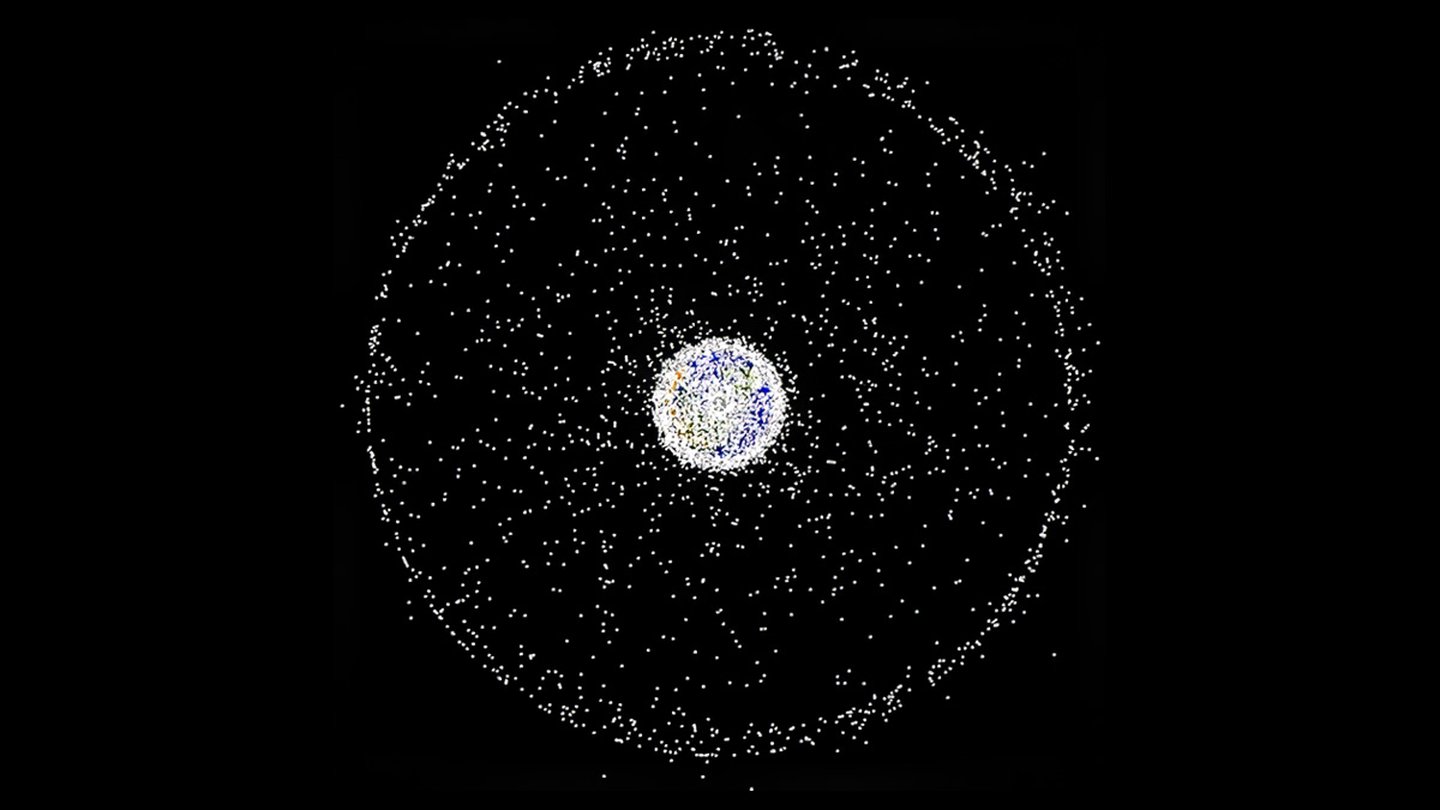
Space has become ingrained in our daily lives — from GPS-enabled apps on our smartphones, to satellites being used to track storms and give weather forecasts, to satellite imagery and communication playing a decisive role in active military conflicts. Every single person on this planet is a user of space-derived data and services in some way, so interruptions or interference in space systems would have consequences for all. This disruption can come from many different places. One that is often overlooked is the increased number of satellites in orbit and how they have the potential to result in (inadvertent) escalation that could affect overall strategic stability.
The international community needs to coordinate these satellites and establish norms around space behavior, or we risk chaos. This is because we have gone from space being a domain where the primary actors are nation-states to one dominated by a singular actor, and that actor isn’t even a country — it is a commercial entity and government contractor, SpaceX. This is a challenge from a stability perspective, because this is not how space governance has been set up.
Because SpaceX is a U.S. company, the United States must make sure that it follows international agreements, such as the 1967 Outer Space Treaty. The treaty lays out principles that nation-state signatories must follow, among them the prohibition of nuclear weapons in space. These principles are further formalized in the 1968 Rescue Agreement (ensuring astronauts landing in foreign countries can get back home), the 1972 Liability Convention (establishing liability for damages by space objects), and the 1976 Registration Convention (requiring states to submit information about their launched objects to the United Nations).
As a non-state actor, SpaceX is not part of international discussions about what new agreements are needed to ensure that guardrails exist for evolutions in space. For example, there are ongoing conversations at the United Nations about how best to share information about tracking objects and activities in orbit known as space situational awareness (SSA), but as of now, there is no definitive agreement about how best to do this. There are additional sources of SSA data, including from commercial companies and national or regional systems, but there is no singular ground truth as to where objects are located in space.
We have gone from space being a domain where the primary actors are nation-states to one dominated by a singular actor, and that actor isn’t even a country — it is a commercial entity and government contractor, SpaceX. This is a challenge from a stability perspective, because this is not how space governance has been set up.
There is an urgency to this work, given that the space domain is changing very quickly, and this is largely driven by the rise of very large constellations of satellites that provide services that people use every day. As of mid-April 2026, there are 15,454 active satellites in orbit. Of these, the United States has 11,671 satellites; Russia, 357; and China, 1,305. Of the U.S. satellites, 10,243 belong to SpaceX’s Starlink constellation.
SpaceX has received permission for spectrum— the radio frequencies that can be used for wireless data transmission — for 15,000 satellites. It has asked the Federal Communications Commission (FCC), which is charged with apportioning spectrum for nonmilitary U.S. space operators, for possibly 30,000 more. Amazon just started launching its very large constellation, Amazon Leo, that is intended to consist of more than 3,200 satellites. China started launching two very large constellations within the last two years, Guowang and Qianfan, meant to comprise about 13,000 and 15,000 satellites, respectively. And this does not even touch upon planned orbital data centers, for which companies this year have submitted filings with the FCC for constellations of 1 million (SpaceX), 88,000 (Starcloud), and 51,000 (Blue Origin), or China’s notification to the International Telecommunication Union in late 2025 of a planned constellation of 200,000 satellites.
These very large constellations are all intended to be in LEO (low Earth orbit) at altitudes of roughly 500 to 1,100 kilometers. Chinese satellites must pass through U.S. constellations to get to their operating altitudes, yet there is no entity in charge of space traffic coordination. There is no one organization whose job it is to work out how satellites should be moved if it looks like there could be a close approach, meaning a possibility of a collision. The U.S. military sends out warnings of potential close approaches to all satellite operators, including Russia and China, as a matter of promoting spaceflight safety. What operators choose to do with that data is up to them. There is no requirement to act on notifications of close approaches, and there is no common understanding of what right-of-way is in space.
These conditions introduce the possibility of two nuclear-armed rivals operating in relatively close altitudes, where situational awareness is imperfect, communication pathways are muddy and strained, and there is no agreement about responsible behaviors in space. This is where an accidental too-close approach could result in an inciting incident where conflict in space leads to conflict on Earth.
We have seen this nearly happen several times already. In December 2021, China told the United Nations that twice in 2021, its space station had to conduct evasive maneuvers to avoid Starlink satellites that it felt were uncomfortably close. And in December 2025, SpaceX reported that a Chinese satellite passed within 200 meters of one of its satellites.
Besides big changes in the number of actors, space is also the site of new activities, which offer additional challenges to existing governance mechanisms. For example, at present, there is no way to remove debris from orbit. Debris moves at very fast speeds, and its impact can damage or even destroy a spacecraft. Our continued ability to receive benefits from our use of space depends on the development of debris removal systems. While this type of technology could be designed for nonaggressive missions, it could also be repurposed into a threat. Any satellite that has the ability to maneuver, track objects, and get up close to dead satellites or pieces of debris can also conduct close approaches and possibly harm other satellites. Intention is hard to know until it is demonstrated, but actions alone can introduce the possibility of inadvertent escalation, as operators may take preemptive steps to protect their satellites against potential threats.
Space should not become a victim of its own success. The rapid progress of space-related technologies and capabilities means that international approaches to ensure its long-term sustainability must match that pace. Otherwise, these disruptions have the potential for global consequences.
Victoria Samson is chief director, space security and stability, for the Secure World Foundation, a Carnegie grantee that is working to strengthen compliance with the Outer Space Treaty by providing a space bootcamp for nuclear security professionals and developing dialogues among nuclear security, space security, and commercial space experts to address security challenges. Samson is a member of the International Astronautical Federation’s committee on space security and the Space Security Working Group of the National Academies of Sciences, Engineering, and Medicine’s Committee on International Security and Arms Control.