

What Does it Take to Explain China to America?
As U.S.-China relations become more complicated, China experts are sharing their knowledge with everyone from the State Department to your local school board
Aug 15, 2025
Describe the problem you’re addressing in five words.
China expertise trapped in academic silos.
Describe your solution in 10 words.
Equip China specialists to communicate with policymakers, media, and the public.
Describe your progress in 15 words.
160 fellows trained across disciplines to engage beyond academia on U.S.–China issues.
More than three-quarters of Americans hold an unfavorable view of China, according to a 2025 Pew survey — but how many of them actually understand the country? In a 2023 paper, China scholar David Shambaugh wrote that his field was failing to communicate its knowledge to the public, despite “very strong demand” from policymakers, businesses, and NGOs, and the media’s “insatiable appetite for China news.” Instead of helping people understand China as a whole, China academics had gotten lost in the jargon-filled weeds of their “narrow subfields of expertise,” argued Shambaugh, a member of the Carnegie-supported Task Force on U.S.-China Policy at Asia Society. “Their research is overly specific and theoretical,” he added, and “not of much use to those outside of the academy.”
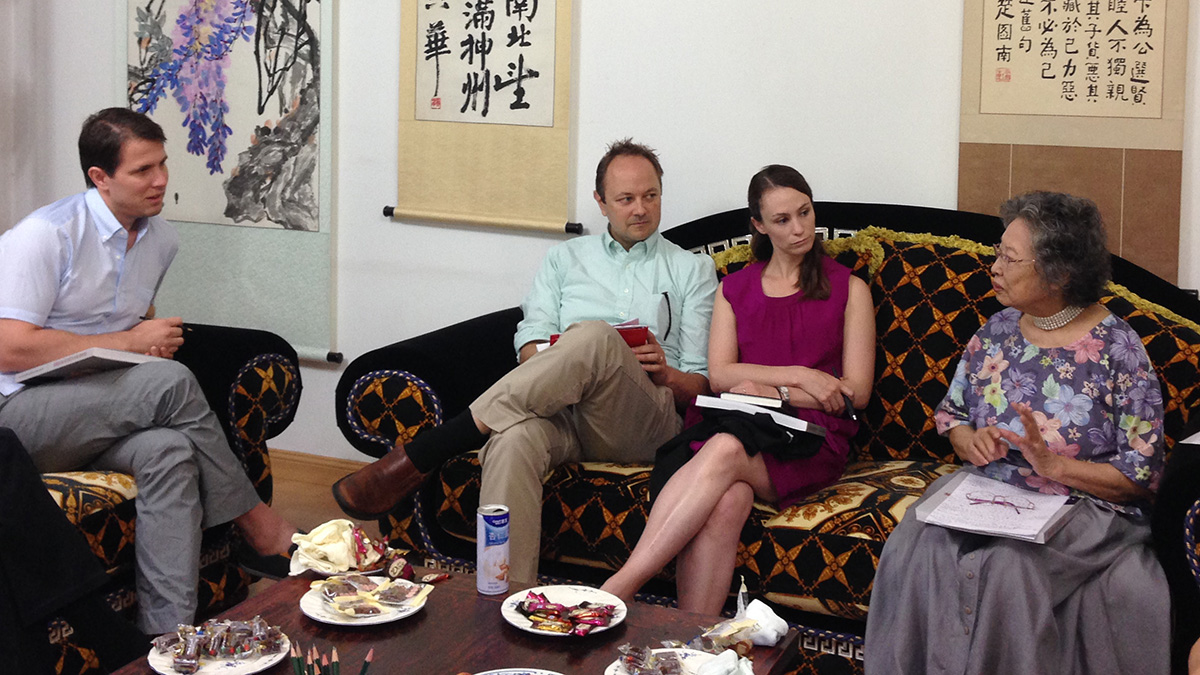
The Public Intellectuals Program is trying to change that. Launched in 2005 by the nonprofit National Committee on U.S.-China Relations and supported by Carnegie since 2014, the program brings together China experts — from historians to anthropologists to political scientists — “to learn from each other and to present their findings outside the ivory tower,” says Jan Berris, the nonprofit’s vice-president. Over the course of a two-year fellowship, the fellows travel to China and surrounding countries, are granted rare access to decision-makers and institutions there and in the United States, and receive training on how to explain their research clearly to everyone from top government officials to the general public.
Having just begun its ninth round, the program has previously supported 160 fellows, who have published more than 80 op-eds and opinion pieces in the last two and a half years, according to Berris. The program emphasizes to fellows that “there are many ways to be a public intellectual,” Berris says. “It doesn’t have to be on NBC Nightly News. You could train a group of schoolteachers, talk to your local newspaper, talk to your local school board about curriculum development.”
Berris says the challenge now is making sure the field doesn’t hollow out. A 2021 report by the National Committee on U.S.-China Relations, funded by Carnegie, found that worsening U.S.-China relations and increasing restrictions in China could “deter new scholars from entering the field and replenishing the pipeline.” In a time when “the hedge is higher, and the thorns are more prickly,” Berris says, “it’s more crucial than ever that we have people who understand both the inner workings of China and this country.”
By the Numbers
77% of Americans hold an unfavorable view of China, according to a 2025 Pew survey. Since 2005, the Public Intellectuals Program has supported two-year fellowships for 160 fellows. They have visited 43 cities in greater China. The most recent group of fellows met with 30+ U.S.-based government agencies and policy-related institutions, and 20+ in Asia. Since 2023, Public Intellectuals Programs fellows have published 80+ op-eds and opinion pieces. Fellows live in 72 cities in 30 U.S. states and the District of Columbia, as well as in China and 9 other countries.