
What Would Andrew Carnegie Think?
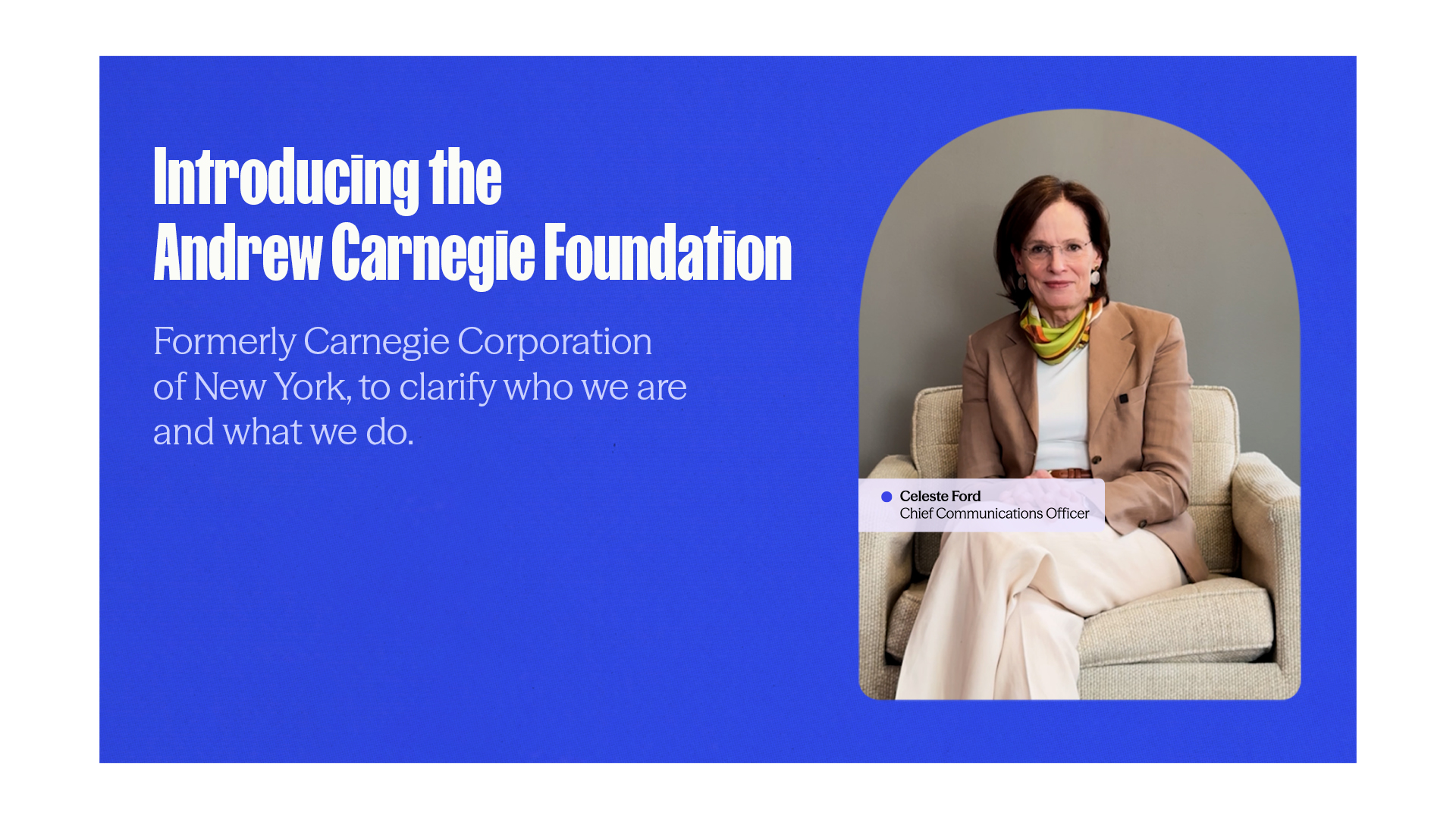
Introducing the Andrew Carnegie Foundation, formerly Carnegie Corporation of New York, to clarify who we are and what we do
By Celeste Ford
Jun 9, 2026

After 115 years, we have changed our name to the Andrew Carnegie Foundation from Carnegie Corporation of New York, an institution whose origins represent a defining period in American philanthropy, but whose name lacks clarity.
Our founder, Scottish immigrant Andrew Carnegie, vowed to give away his fortune after selling his steel company for nearly $500 million in 1901. Ten years later, Carnegie had already established more than 20 institutions in the United States and Europe, including Carnegie UK, the Carnegie Hero Funds, Carnegie Endowment for International Peace, and Carnegie Foundation for the Advancement of Teaching. He still had $150 million to give away, and at age 76, Carnegie was running out of time.
To disburse the rest of his money, Carnegie founded what was then the largest single grantmaking foundation ever recorded. He had exhausted the more conventional names with his other institutions, so he settled on Carnegie Corporation of New York. The foundation’s charter was signed into law on June 9, 1911, in New York City, the culmination of Andrew Carnegie’s philanthropic vision for doing “real and permanent good in this world.” His philosophy was detailed in Carnegie’s 1889 essay “The Gospel of Wealth,” which still stands as an influential guide to giving that has inspired generations of philanthropists.
In the early 20th century, grantmaking foundations were rare, and the word “corporation” did not carry the commercial connotations it often does today. Over the decades, our name became a source of growing confusion, especially among our sister institutions, which often have vastly different missions. For instance, the Carnegie Institution of Washington (a scientific research center founded in 1902) changed its name to the Carnegie Institution for Science in 2007 and is now known simply as Carnegie Science.
We are a philanthropic grantmaking foundation, not a corporation, and our funding supports organizations working in education, democracy, and peace across the country and the world, not just New York. Andrew Carnegie possessed remarkable foresight and anticipated that circumstances would change. In his 1911 instructions, he granted his trustees full authority to change policies or causes as they saw fit, noting:
“They shall best conform to my wishes by using their own judgment.”
On June 9, 2026, our 115th anniversary, we honored his wishes and changed our name to the Andrew Carnegie Foundation. We want to underscore the association with our founder and to provide clarity about who we are and what we do, helping to ensure the public’s trust in our philanthropic mission. As an added tribute, our new logo features Andrew Carnegie’s signature, written in fountain pen, from the foundation’s archives at Columbia University. We’ve also introduced a redesigned website, Carnegie.org, where the logo appears in context as part of our new visual identity.
None of these changes address the question we are asked most often: “How do you pronounce Carnegie?” The foundation would like to avoid a definitive answer and the prospect of more lighthearted debate. We favor our founder’s pronunciation, car-NAY-ghee. Other versions reflect regional differences, particularly CAR-neh-ghee. We invite you to pronounce Carnegie however you prefer, but please remember to call us by our new name: Andrew Carnegie Foundation.
Celeste Ford is the chief communications officer of the Andrew Carnegie Foundation.