
What Is the Role of Migration and Displacement in Global Conflicts?
New research and tools are exploring contemporary questions of peace, conflict prevention, and governance
By Matt Schiavenza
Nov 4, 2026
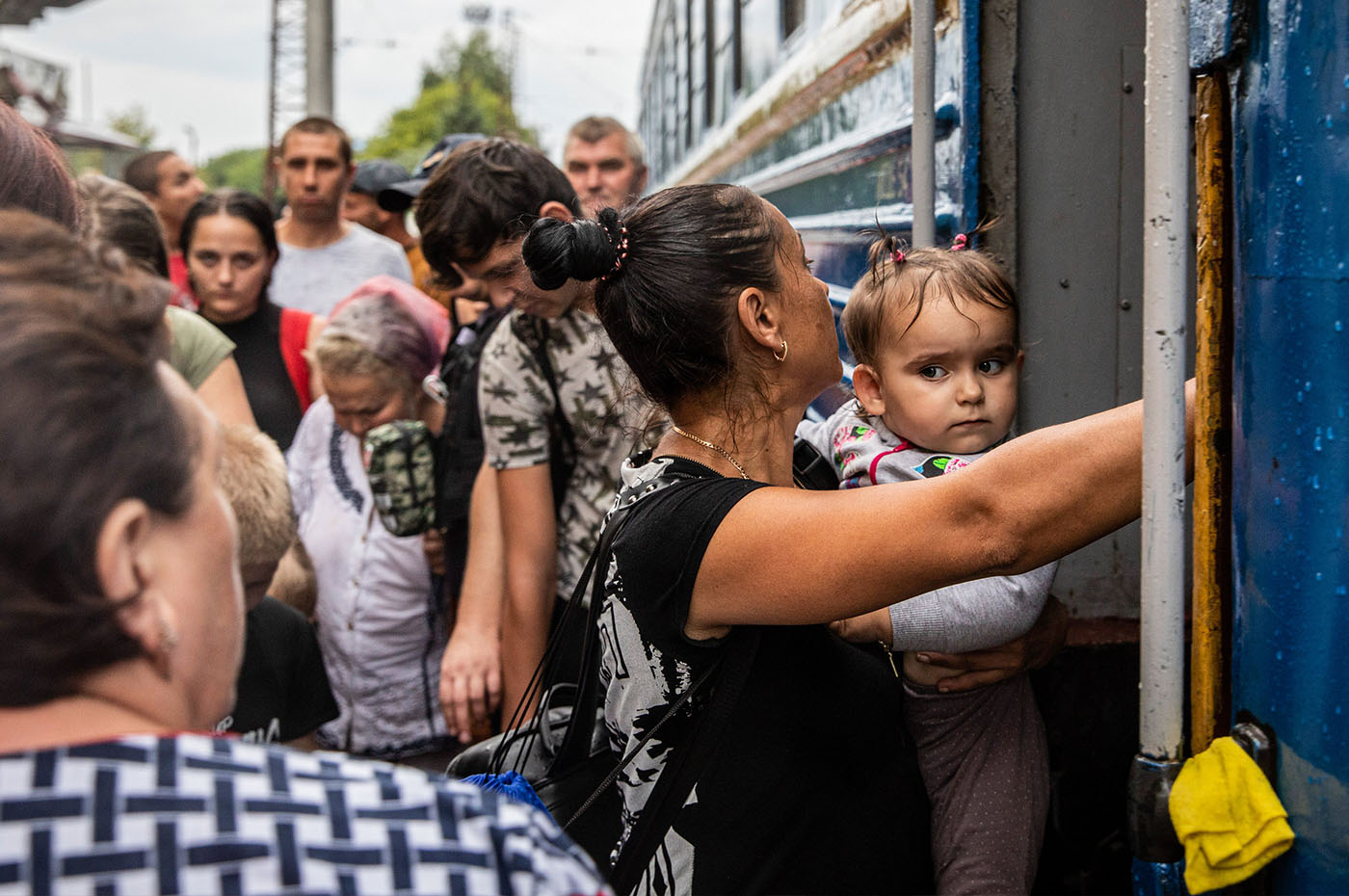
When tens of thousands of Ukrainian children were taken to Russia and Belarus following the Russian invasion of Ukraine in 2022, the United States government turned to the Yale Humanitarian Research Lab to investigate their whereabouts. Using satellite imagery and open-source materials, researchers at the lab noticed that mayors of Russian cities would take selfies of themselves with children and post them to Telegram, a social media platform, but neglected to remove location data, allowing the research lab to learn where the photos were taken.
In one case, the lab collected and analyzed satellite images that, from 450 miles above ground, confirmed that children were using a pool at a summer camp. The lab found that Ukrainian children had been taken, either temporarily or indefinitely, to at least 210 facilities inside Russia and Russian-occupied parts of Ukraine. At these sites, which included summer camps, sanatoriums, hospitals, and military bases, the lab uncovered evidence that children were illegally adopted and underwent military training and reeducation.
The lab’s work led to International Criminal Court indictments for the war crime of unlawfully deporting and transferring children and a formal State Department determination in 2023 that Russia had committed crimes against humanity. It also demonstrated a powerful new tool that, under the right circumstances, can help enforce accountability.
“When I started as a human rights investigator in 1999, our primary modality for gathering intelligence was witness testimony,” said Nathaniel Raymond, executive director of the Yale Humanitarian Research Lab, a Carnegie grantee. “The problem is that this put people at risk, and it was slow. Now, with remote sensing, we’re able to collect empirical, scientifically validated information without putting witnesses at risk — not only after an event happens, but before.”
Sixty-one active armed conflicts were recorded globally in 2024, leading to almost 160,000 fatalities, according to researchers at Sweden’s Uppsala University. That is the highest number since data collection began in 1946. More than 117 million people were displaced around the world in 2025 as fighting in Sudan, Ukraine, and elsewhere has also forced millions of civilians from their homes.
The evolving nature of conflict is at the center of the International Program’s work at Carnegie to support a more peaceful world. Grantmaking aims to further understand how warfare is changing faster than the institutions built to prevent and manage it, and how many current conflicts around the world are occurring below the threshold of open war, with cyberattacks, sabotage, political interference, disinformation, and the use of proxies eroding the line between war and peace.
This article features eight grantees that are exploring contemporary questions around peace and governance, and how better tools, evidence, and local partnerships can meaningfully shift how these challenges are understood and addressed.
Tools for Seeing How Conflict Drives Displacement
The modern legal structure administering the global movement of people emerged in 1951 with the Refugee Convention, an agreement that initially addressed post–World War II forced migration in Europe and was ratified by 145 countries. The convention laid out clear guidelines for cross-border movement but excluded internally displaced persons — people forced from their homes who remain within their country’s borders. This distinction has current relevance: of the 117.8 million people displaced today, more than half are displaced internally. Today’s conflicts, many of which are never resolved, do not align neatly with the convention’s focus on large-scale wars that start and end and involve peace agreements.
In recent years, the Sahel region, a vast belt situated between the Sahara Desert to the north and Africa’s humid savannahs to the south, has emerged as a major security challenge. Military coups have toppled civilian governments across the region, while Jama’at Nusrat al-Islam wal Muslimin, an affiliate of al Qaeda, has become a serious threat. By March 2025, an estimated 378,000 people were internally displaced in Mali, driven out of their homes by government instability and at risk of terrorist violence.
“Now, with remote sensing, we’re able to collect empirical, scientifically validated information without putting witnesses at risk — not only after an event happens, but before.”
Nathaniel Raymond
Executive Director, Yale Humanitarian Research Lab
For over 15 years, V.S. Subrahmanian, a professor at Northwestern University, has studied the use of algorithms to model the behavior of terrorist organizations, using dozens of variables to project whether an attack may happen within a two- or three-month period. His work has covered a wide swath of global terrorism, encompassing groups as disparate as Lashkar-e-Taiba on the Indian subcontinent and Boko Haram in Nigeria. With Carnegie’s support, Subrahmanian is now working to create a map that will predict the movements of terror groups in Mali as well as the environmental and logistical risks that may prevent internally displaced people from reaching safety.
“I’ve always thought of the project as a kind of Google Maps for refugees,” Subrahmanian said. Using artificial intelligence (AI), Subrahmanian and his team can predict the risk of attack by location and timing. “The AI creates a plan to get people to their destination, identifies the destination in the first place, and generates the safe route — all three of which depend on each other,” he said.
Where Subrahmanian’s algorithm may predict the movement of terrorist groups that threaten migrants, a Carnegie-funded project at the Danish Refugee Council is studying how displaced populations form in the first place, using Nigeria and Colombia as pilot countries. Based on more than 120 open-access datasets, the project, referred to as the Ahead Model, offers accurate predictions of how many people will be uprooted in a particular location three to four months into the future, giving local organizations on the ground a chance to inform vulnerable communities. “Our initial analysis shows that community members often stay put for too long because they don’t want to risk financial loss by abandoning their livelihoods,” said Lena Huhn, a lead researcher on the Danish council’s project. “We try to mitigate that.” Teams work with community groups, faith-based organizations, and other institutions that have already developed local relationships to inform communities.
“My vision and hope is that the power of technology is used for good — that predictive intelligence is used for preemptive action,” Huhn said. “We can reduce forced displacement and its humanitarian consequences when we act early. It means families can bounce back faster after the shock.”
Arguments for Good Governance and Improving Economic Conditions
Economic conditions are a key driver of mobility decisions. In a 2023 report, the United Nations Development Programme asked members of extremist groups in Africa to cite their motive for joining. Thirty-one percent cited an “urgent need of livelihood opportunities,” while 73 percent said their government was doing a “bad job” at providing employment. According to Afrobarometer, a research organization, nearly half of adults surveyed across 24 African countries have considered emigrating for work.
Two projects funded by Carnegie grants seek to address this problem. Researchers at the ONE Campaign are looking at which external institutions have developed effective mechanisms for employment and investment, using that as a model for jumpstarting broader economic engagement.
“What we hear from Nigerians, Kenyans, and others is that they want jobs and investment, not charity,” said Elizabeth Hoffman, executive director for North America at the ONE Campaign. “They want to pull themselves up from their bootstraps — they just need a level playing field and the opportunity to do that.”
A project at the African Institute for Development Policy, meanwhile, will examine how migration and displacement policies function in practice, conducting youth-centered surveys to understand what drives the movements of people across the continent. Are migrants filling much-needed labor gaps in other countries? Or are they causing tension by competing for scarce resources? Why do certain migration patterns in Africa lead to fighting and others do not?
“African countries are at different stages of development, and how they handle migration will affect the country’s future development in a number of ways,” said Eliya Zulu, executive director of the African Institute for Development Policy and a lead on the project.
The Economic Community of West African States has, since the late 1970s, permitted free movement of people within its member states, a model for economic integration on the continent. But violence that forces people from their homes has, in recent years, led to additional challenges, as governments within the bloc struggle to keep transient populations from exacerbating tensions. “There’s a hope that once the Sahel stabilizes, these people will return home,” said Pauline Bax, a Johannesburg-based expert at the International Crisis Group.
“We can reduce forced displacement and its humanitarian consequences when we act early. It means families can bounce back faster after the shock.”
Lena Huhn
Global Lead on Anticipatory Action, Danish Refugee Council
Migrants throughout Africa have embedded themselves in the regional economy and have shown entrepreneurial skill: a World Bank study found that the Kakuma refugee camp, located near the Kenya–South Sudan border, generates $50 million in economic activity a year. Despite this impact, refugees and their advocates are still often excluded from decision-making at the highest level.
“Refugees are seen as vulnerable and marginalized, with nothing to contribute, or as a security concern,” said James Milner, codirector of a Carnegie-funded project at Carleton University. “When regional bodies meet, community-based groups, refugees, and indigenous populations traditionally haven’t had a seat at the table.”
Carleton’s project will mobilize indigenous and refugee-led research networks across the continent, helping to provide local knowledge to decision-makers who can influence policy. “Our project will document knowledge that already exists and empower a new generation of researchers who live and work in these communities,” he said.
Developing Infrastructure for Peace Through Legal Pathways and Policy
Since the fall of the Assad regime in Syria in December 2024, around 1.67 million refugees and 1.92 million internally displaced people have returned. While these numbers are substantial, they are only a fraction of the people who fled. More than 5.5 million people are still internally displaced within Syria, and nearly 5 million Syrian refugees remain outside of the country. Even those who have returned home have endured multiple challenges: destroyed homes, incomplete property records, limited employment opportunities, poor infrastructure, and physical remnants of Syria’s civil war. Host governments in the region that accepted Syrian refugees during wartime are under political pressure to return them, adding to the sense of urgency that these obstacles to peaceful return are resolved.
“If people return to Syria faster than the country is ready to absorb them, and without adequate safeguards, the consequences could include renewed displacement, localized conflict over housing and resources, and instability that undermines the broader transition — not just for returnees but for Syria as a whole and subsequently the region as well,” said Natasha Hall, a project director for Refugees International.
In a Carnegie-funded project, Refugees International aims to ensure that the return of Syrians to their homes avoids these risks. Among other goals, its work will provide recommendations to policymakers and practitioners for managing this process and establish a platform through which disparate organizations involved with displaced Syrians can engage with the Syrian government on policy.
Researchers at the Migration Policy Institute are focusing on another key element of governance: expanding pathways for legal migration. Meghan Benton, director of global programs, is leading a Carnegie-funded project that is examining how government bottlenecks make regular migration more difficult, incentivizing would-be migrants to consider smugglers. “Irregular migration is genuinely harmful,” said Benton. “But if you want to move people through regular channels, you have to have slick, user-friendly, accessible systems.”
Benton reports that these bottlenecks are often logistical in nature. In Senegal, for example, it can take a significant amount of time to secure an appointment at a European consulate, while Filipinos wanting to emigrate to South Korea must travel to Manila to pass an in-person language exam. Benton’s project is working to show how well-designed legal pathways can reduce the threat of violence to migrant populations, partnering with the Behavioral Insights Team to conduct an audit designed to identify and eliminate blockages in government systems.
“What replaces the fear and coercion that defined so much of the past is governance, accountability, economic opportunity, and meaningful participation,” said Natasha Hall of Refugees International. “That is the work of the next decade.”
Matt Schiavenza is the senior content editor and writer at the Andrew Carnegie Foundation.