Preventing Hate-Fueled Violence
Eradicate Hate Global Summit is driving a culture of prevention of hate crimes. Learn more about warning signs and how to take preventive actions
By Matt Schiavenza
Nov 18, 2026

Five years ago, the first Eradicate Hate Global Summit was convened in response to the October 27, 2018, mass shooting at the Tree of Life Synagogue. Eleven people were killed and others were injured when a 46-year-old man entered the synagogue in Pittsburgh’s Squirrel Hill neighborhood and opened fire on the congregation. The killer had, in the period leading up to the attack, posted antisemitic and anti-immigrant content on social media.
The summit was launched to discuss and promote ideas for combating hate and preventing hate crimes and other acts of hate-driven violence. It has grown considerably: in September 2026, it featured more than 1,600 participants, up from 125 in 2021. The nonprofit organization now offers year-round programs designed to build the capacity of local communities and practitioners.
In this conversation, Eradicate Hate Global Summit President Brette Steele tells Carnegie how targeted interventions can prevent hate-fueled threats from turning into violence.
Matt Schiavenza: What makes hate-fueled violence challenging to eradicate?
Brette Steele: It is often based in fear. It can be based on visceral hatred, but it’s often driven by fear of the unknown or fear of what might happen.
Hate-fueled violence doesn’t just target the individual or group against whom the attack is directed. It strikes terror in the entire community. The Tree of Life killing sparked fear in Jewish communities across the United States, but because the killer’s online posts also included anti-immigrant elements, it struck fear among immigration and service providers as well.
Matt Schiavenza: What tools can people use to reduce hatred in their communities?
Brette Steele: One thing we emphasize across all our campaigns and resources is recognizing warning signs. In over 80 percent of school shooting cases, someone knows something before it occurs, and yet often people don’t say anything because they don’t want to get someone they care about in trouble.
Our campaigns for both youth and adults share the most common warning signs. These include statements that sound like a goodbye, posing with weapons, or sharing hate-based propaganda. We also provide guidance for parents and teachers on how to talk to young people about these concerns.
Matt Schiavenza: Where can people go for help?
Brette Steele: We’re building the capacity of psychologists, psychiatrists, social workers, and the social services sector more generally to treat individuals at risk of committing an act of violence, rather than dismissing their words as a fantasy or joke. We developed the first-ever continuing education course on this topic for the American Psychological Association and are building courses for social workers right now through one of our working groups.
We’ve built the Reach Out Resource Hub, a curated list of clinically licensed providers as well as a whole range of prevention resources that will give people the confidence that the person they call will understand the risk and know what to do about it. It’s about driving a culture of prevention: helping people understand that prevention is possible and knowing how to achieve it.
We also created a campaign for youth ages 12 to 22 called UP End Hate, in which we trained 334 young people on seven concrete actions they could take to prevent hate-fueled violence. Those students documented over 130 actions they took to intervene during a single school year. Most concretely, there were two reports from students about guns spotted on campus.
Matt Schiavenza: Carnegie has supported your organization since 2022. What will the most recent grant enable you to do?
Brette Steele: The Carnegie grant will allow us to continue to grow our programs for youth, giving them skills and resources to prevent hate-fueled violence on their campuses and in their communities.
When we look at school-based violence, or all forms of hate-based violence, the people in the best position to pick up on attack planning are peers. In school shootings where at least one person knew about the attack in advance, 93 percent of the people who knew were peers.
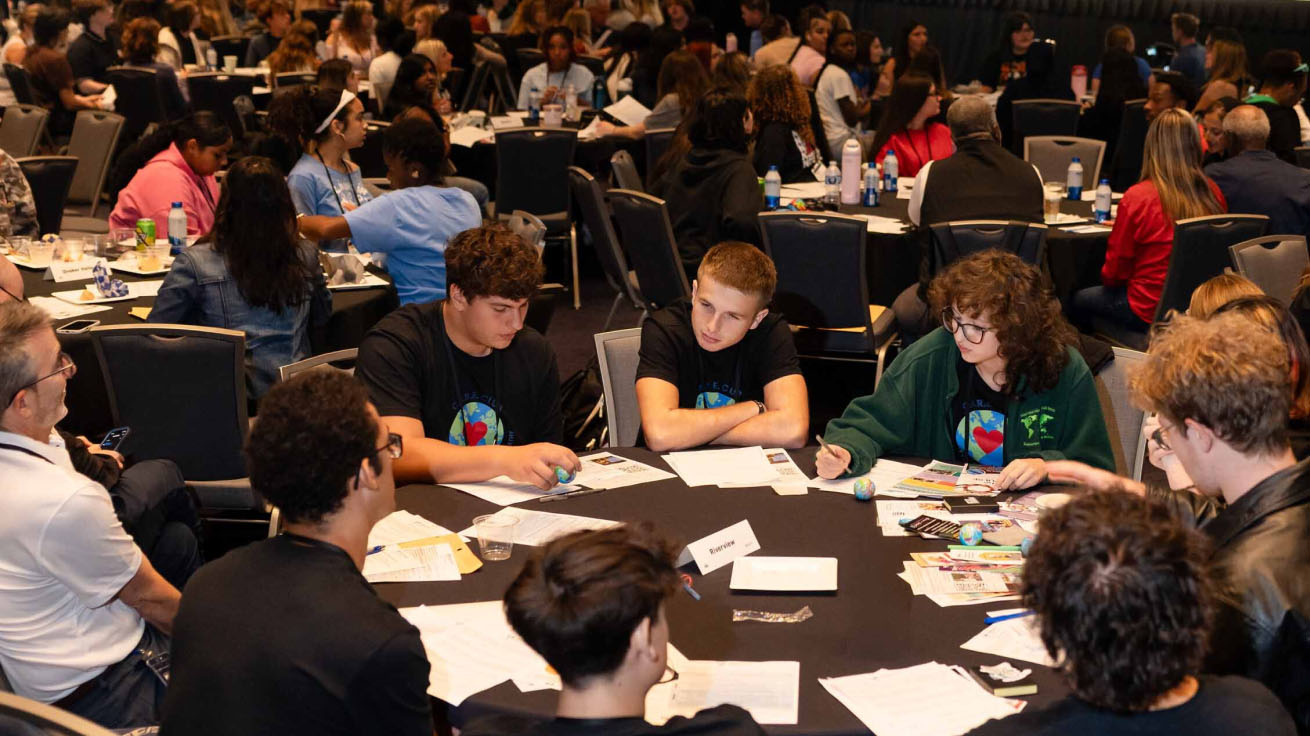
The grant will also enable us to scale up initiatives like our Student Summit. Last year, students from 35 schools in three counties gathered for a summit in Pittsburgh, where they heard from survivors and planned campaigns for their own schools. We wrote a guide so other communities could run their own version of the event, and now communities in Philadelphia, Northern California, and Phoenix have expressed interest in doing their own student summits.
Seven concrete actions you can take to stop someone from getting hurt:
- Say something positive about a person or group when you hear hateful things about them.
- Show up for someone after they have experienced hate.
- Help someone think about why their actions are hurtful and what other choices are available to them.
- Change the subject and interrupt hate as it’s happening.
- Tell the person acting hateful that their words and behavior are not OK.
- Take time to really understand what someone is saying. Practice noticing and responding to another person’s feelings and show your interest in the conversation.
- Seek help. You might see or hear something that you feel is too important to keep to yourself or address on your own. When in doubt, tell a trusted adult.
Matt Schiavenza is the senior content editor and writer for the Andrew Carnegie Foundation.