
Legal Information
Here you can find the terms of use for the Andrew Carnegie Foundation’s website, our privacy policy, and a notice about the copyright of materials presented on this website, as well information on governance and financials.
Financials
Here you can find information about how the Andrew Carnegie Foundation manages its budget through a spending policy, as well as financial and investment reports.
Spending Policy
The foundation adheres to a spending policy that is designed to weather short-term market fluctuations to provide better predictability and long-term stability in grantmaking. This helps sustain the foundation’s grantmaking efforts in bad times as well as good, allowing us to fulfill Andrew Carnegie’s legacy of using private wealth for the public good in perpetuity.
To lessen the impact on the budget from short-term market volatility, the foundation uses a process known as “smoothing.” A common form of smoothing is to target spending at a specified percentage, not of the current market value of the institution’s assets, but of a moving average of market values.
The foundation uses an equally weighted, 12-quarter-end lagging average of the assets’ market value to calculate its 5.5 percent yearly spending target.
When smoothing the budget, actual spending percentage in any given year deviates from the spending target by a different amount each year. When markets are up, actual spending drops below the yearly spending target because the average market value is below the current value. And, when markets are down, actual spending rises above the target percentage for the same reason. Over the long run, budget smoothing should result in an actual payout rate of 5.25 percent, compared to the target’s 5.5 percent rate.
During periods of extreme market dislocation, such as the period from late 2008 through early 2009, the foundation retains the ability to adjust its spending allocation in order to enhance preservation of capital for the long term. During these periods, unduly high levels of spending could jeopardize the foundation’s mandate of preserving purchasing power net of spending.
In the Deed of Gift establishing the foundation, Andrew Carnegie clearly spelled out that the foundation was created to carry out its philanthropic work in perpetuity, so that “even after I pass away the [wealth] that came to me to administer as a sacred trust for the good of my fellow men is to continue to benefit humanity for generations untold.”
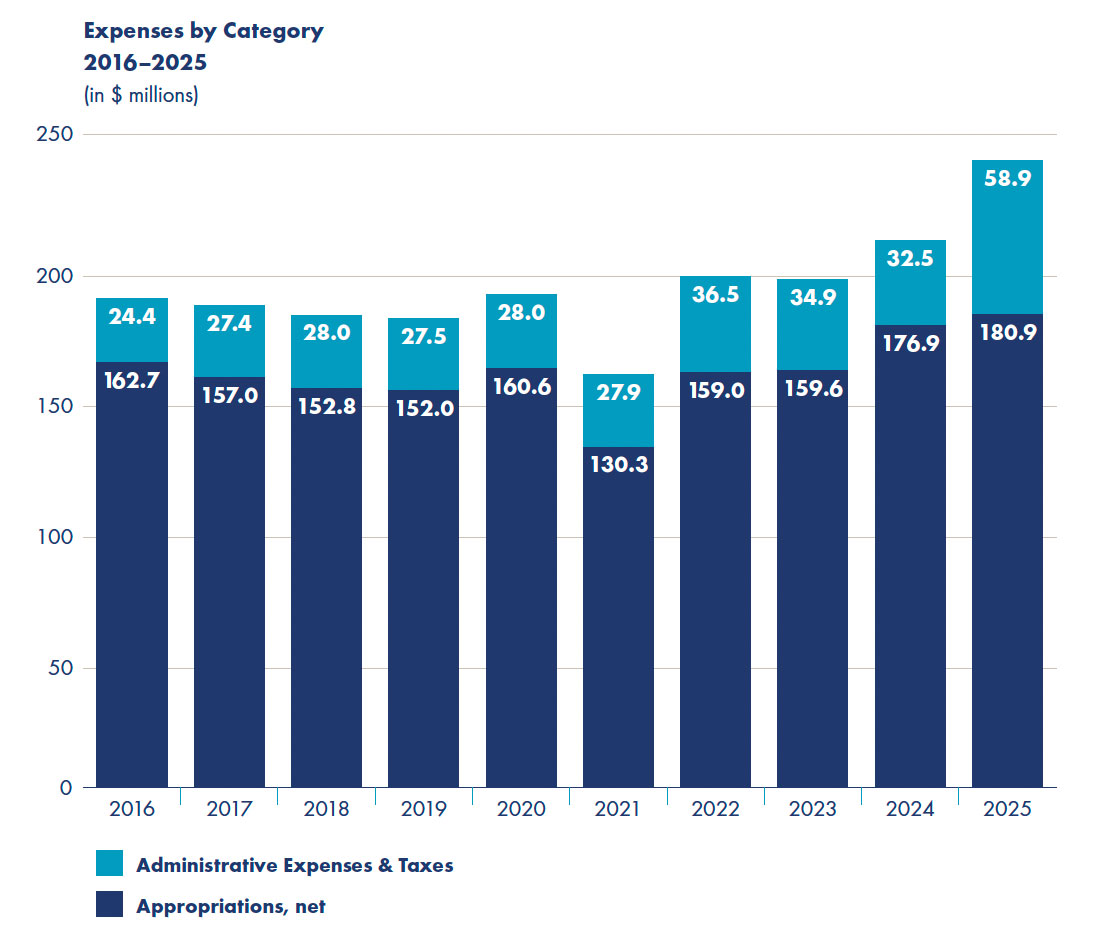
For the 10 years ended September 30, 2025, the foundation awarded 3,761 grants totaling $1,591.8 million and incurred expenses of $284.5 million for program management, direct charitable activities, and administrative expenses, excluding investment expenses, and $41.5 million for taxes, for a total of $1,917.8 million.
The graph below illustrates the change in expenses by category over the 10-year period ended September 30, 2025.
Reports
The foundation’s annual report contains both a report on financials — which includes financial highlights, an independent auditor’s report, balance sheet, statements of changes in net assets, statements of cash flows, and notes to financial statements — as well as a report on investments, which is a narrative from the chief investment officer on performance of the foundation’s portfolio for the fiscal year ending September 30.
The foundation’s Form 990-PF is available upon request.