
How Libraries Became ‘First Responders’ for America’s Opportunity Gap
Last year, the New York Public Library’s English classes were attended 200,000 times — and it still can’t keep up with demand
Aug 19, 2025
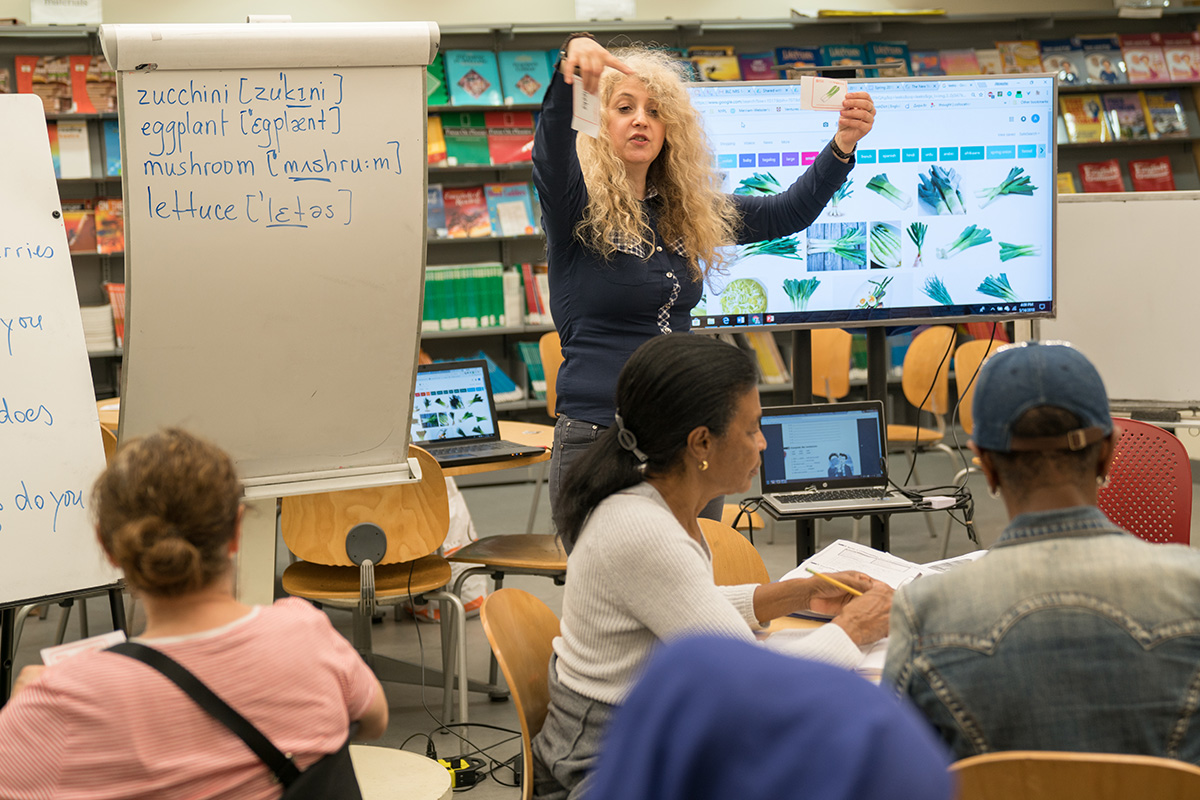
Around 8 percent of people in the United States — more than 25 million — have limited English proficiency. One of them is Gabriela, who in 2020 moved from Colombia to Plainfield, New Jersey, and struggled to afford private English lessons between working long shifts at a grocery store.
Then she discovered free English classes at the Plainfield Public Library. Recently, after spending six months on a waitlist, she finished the library’s once-a-week Level 1 course.
Now, she says, she’s gained confidence at work and has even used English to interview for higher-paying jobs. She intends to continue with the library’s Level 2 course, funded by a new grant from Carnegie Corporation of New York.
Libraries as Ladders of Opportunity
Gabriela is among a growing number of people learning English through free library programs across the country, from language classes to college access workshops. In recent years, public libraries have become the “front door to services,” says Scott Kuchinsky, who oversees Plainfield Public Library’s English language services, digital literacy, adult education, and job search programs. “These are all nontraditional library services, but they’re consistent with this idea that libraries are the people’s university.”
Adult education programs are vital to immigrants in communities like Plainfield, which became a majority-Latino community for the first time in 2020. Around 35 percent of the city’s residents speak English “less than well,” up from 27 percent in 2010.
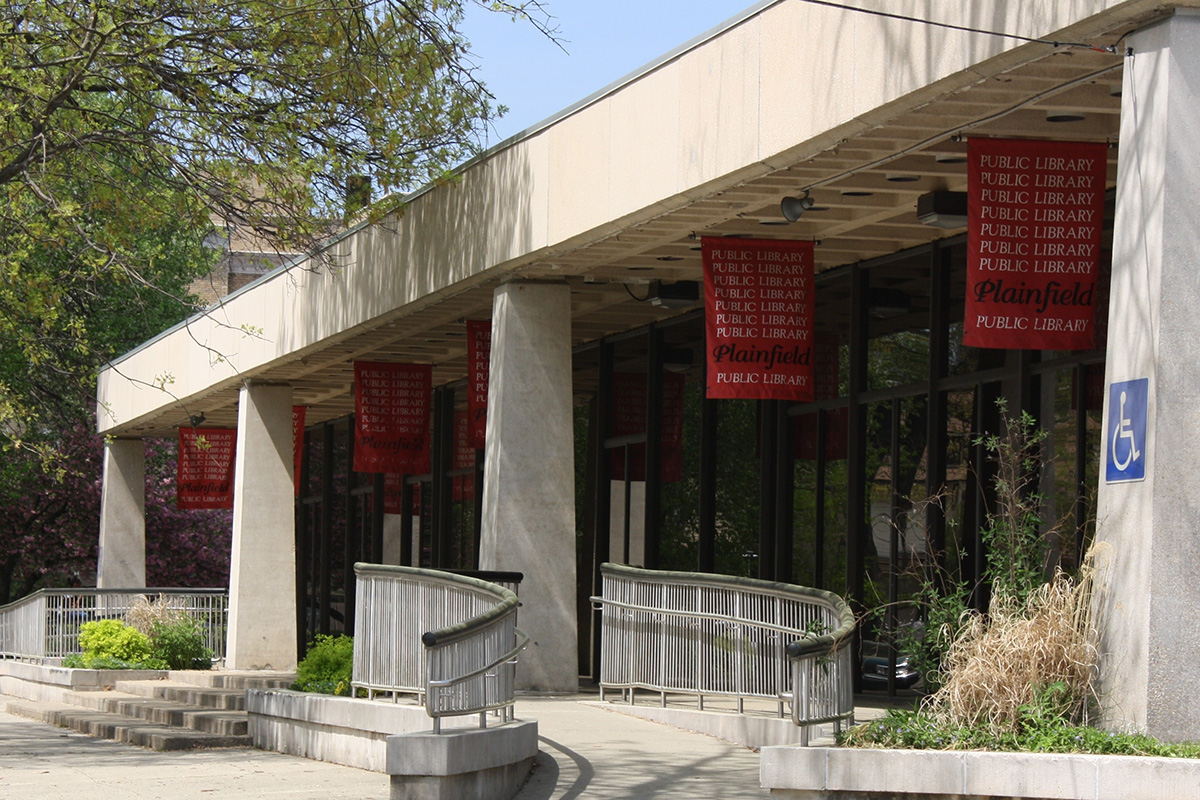
In recent years, public libraries have become the “front door to services,” says Scott Kuchinsky, who oversees Plainfield Public Library’s English language services. (Credit: Plainfield Public Library)
Yet as the number of people with limited English proficiency increases in Plainfield and across the country, public funding for adult education has trended downward, according to research by Blake Heller, a University of Houston professor, and Kirsten Slungaard Mumma, a Columbia University professor. In a 2024 study, the researchers estimated that less than 2 percent of potential English language students were enrolled in a program in 2021, noting evidence that English language programs are “failing to meet demand … with some programs waitlisting hundreds of students for months or years.”
Despite tight resources, libraries across America are trying to meet the need. “I see libraries as a first responder to the rapid changes that we’re seeing in our times,” says Brian Bannon, the Merryl and James Tisch Director of the New York Public Library, which in 2024 received a Carnegie grant to expand its English language services, workforce development, and teen services. “We’re nimble. We’re embedded in neighborhoods, as designed by Andrew Carnegie,” says Bannon. “In many neighborhoods, we are the most accessible, trusted, and consistently open public institution.”
Demand is strong. In its 2024 fiscal year, the New York Public Library’s English language program attendance surpassed 200,000, says Bannon, making it the largest provider of free English language education outside of New York City’s school system — but “classes fill up fast, and there are long waitlists.” Similarly, “demand is exploding” for the library’s workforce services, Bannon says. Its free one-on-one career coaching classes are booked weeks in advance and its teen programs, which included college and career assistance, were attended more than 118,000 times in the 2024 fiscal year.
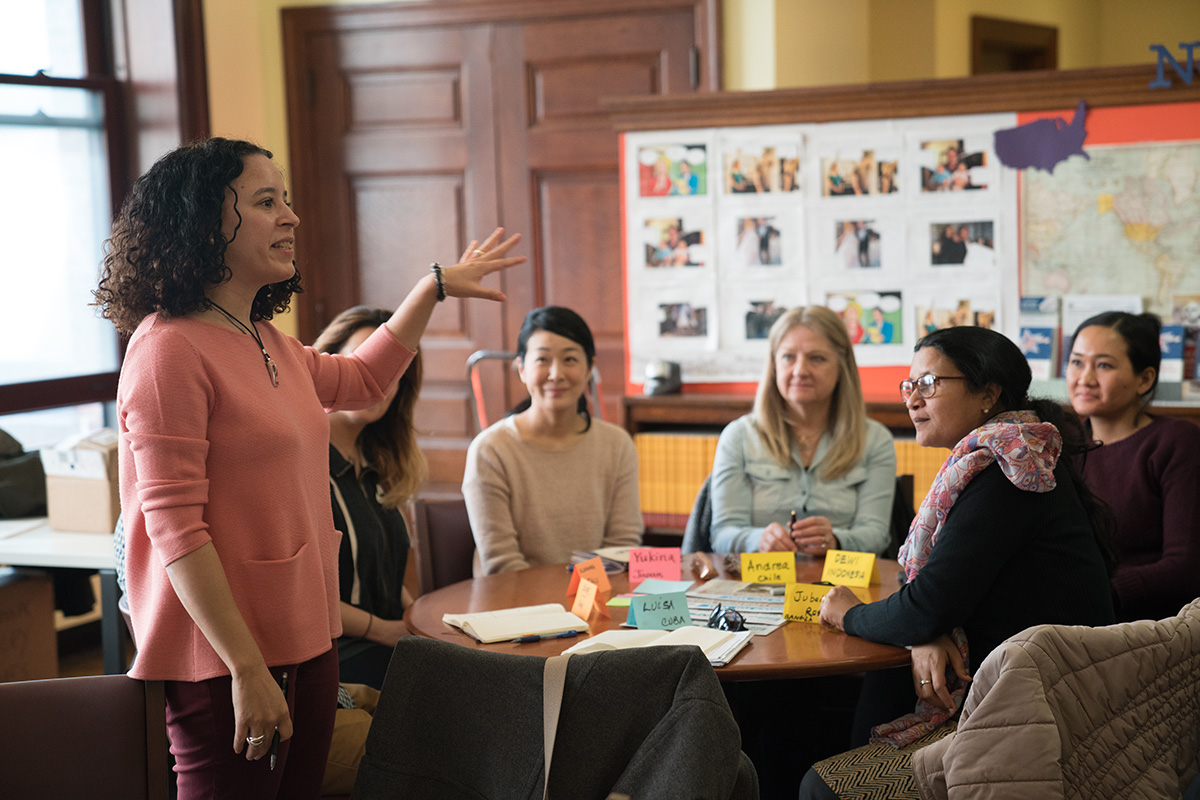
There are long waitlists for New York Public Library’s English language classes. (Credit: Jonathan Blanc / New York Public Library)
“It’s a sobering moment in many ways,” says Bannon. “It’s also a moment where we have to respond quickly, and it turns out libraries are designed to do that.”
That’s why libraries are meeting the challenge together — with help from philanthropy. In June 2025, San Diego Public Library, Plainfield Public Library, and nine other public library systems were awarded a total of $5 million in new Carnegie grants, after responding to the foundation’s nationwide request for proposals. The initiative, “Libraries as Pillars of Education and Democracy,” drew over 1,400 submissions, including 100 from rural libraries. Patrick Stewart, CEO of San Diego Public Library Foundation, sees an opportunity to exchange knowledge with the other grantees, who were selected for geographic diversity and their service to under-resourced communities. “We share, learn, teach, and mentor each other,” says Stewart. “What are our friends dealing with in San Jose, or Prince William County, Virginia? This will be really helpful.”
Carnegie’s Legacy of Access, Renewed
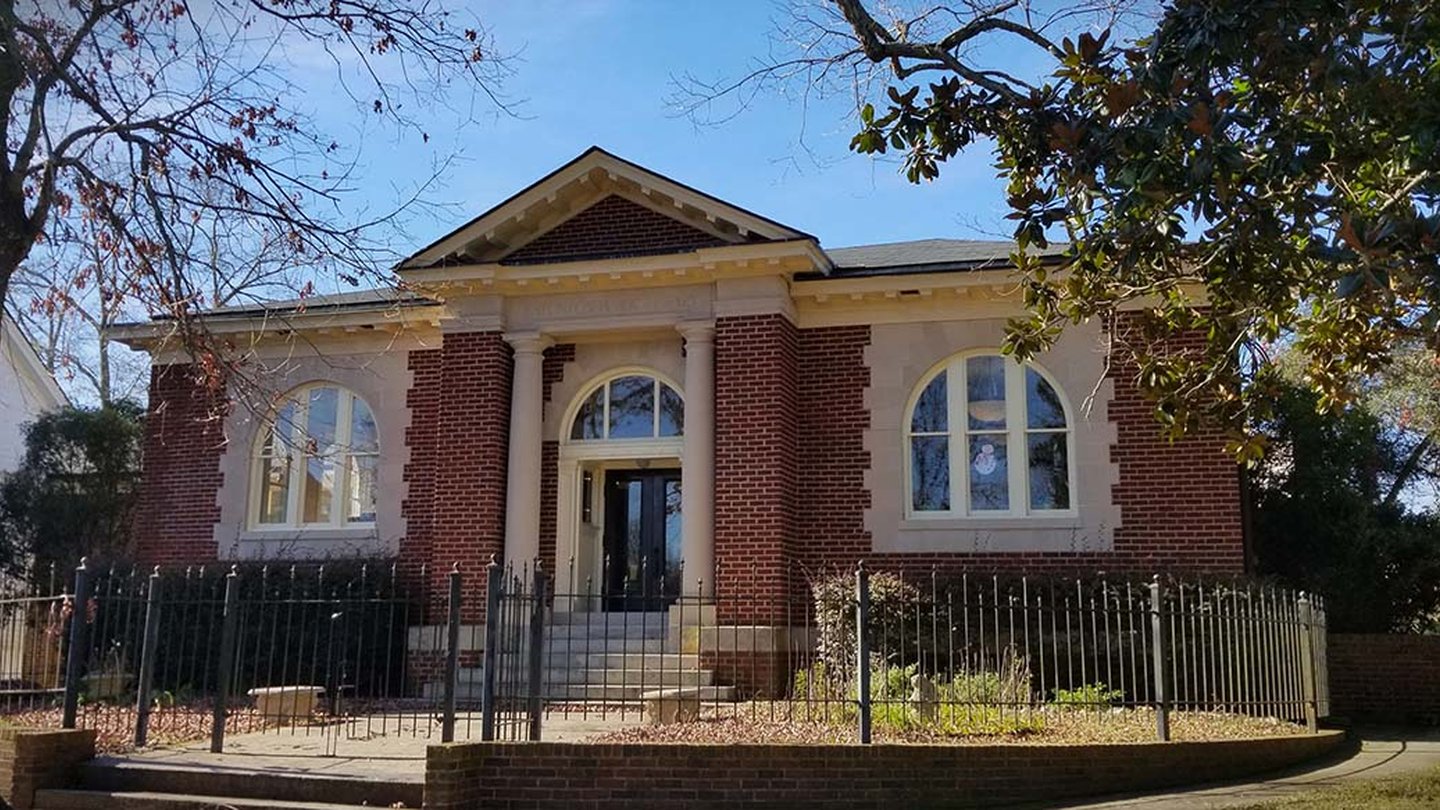
Starting in the 1880s and over the next four decades, Scottish immigrant and industrialist Andrew Carnegie and his foundation funded the constructions of about 2,500 libraries worldwide, including nearly 1,700 across the United States — at the time, equaling around half of all public libraries in the country. He saw libraries as an essential resource for people of all backgrounds to seek opportunity and integrate into American society, calling them “ladders provided upon which the aspiring may climb.”
Since their opening days, many Carnegie Libraries have offered English education, which Andrew Carnegie saw as essential for immigrants to participate in democracy and pursue the American dream. His intuition is backed by modern research. In their 2023 study, Heller and Slungaard Mumma, the education researchers, found that adults who enrolled in public English language classes in Massachusetts reported 56 percent higher earnings after two years — generating increased tax revenues equal to a 6 percent return on taxpayer dollars — and were also twice as likely to become a registered voter.
Yet with limited public funding, English language education is offered by as few as 17 percent of libraries, according to a 2022 survey by the Public Library Association, a division of the American Library Association, a Carnegie grantee.
Through the Carnegie grant, Plainfield Public Library is increasing its English language offerings. Gabriela’s once-a-week class has doubled to twice a week and the library is expanding its higher-level curriculum. Jose Sanchez, a beloved English language teacher who has taught part-time at the library since 2024, is going full-time. “Now I can do a lot more,” Sanchez says. “I’ve started developing a workbook for Level 2, and a guidebook to train new tutors.”
With her new English skills, Gabriela hopes to apply for a cashier job paying $17 an hour, up from the $15 an hour she makes working in the stockroom. Another student, Marta has been working at a Plainfield laundromat for 18 years. Now that her English has improved, she hopes to become a real estate agent. Their classmate, Melania, studied business in her native Honduras, and after she masters English, she hopes to continue her education in the United States so that she can open her own business here. (According to the Migration Policy Institute, immigrants are more likely than U.S.-born workers to be overeducated for their positions, due in part to lower levels of English proficiency.)
Supporting the Next Generation
As adult learners rewrite their futures through English classes, libraries are also reaching out to teens facing academic and economic obstacles.
When Jazmin was in eighth grade, her parents pulled her out of school. Her brother, a tenth grader, had dropped out to help the family make money. Her parents, neither of whom finished high school, “thought that it would be more helpful if we both dropped out together,” she says.
But she quickly realized she belonged in the classroom. She told her parents she understood the family needed help, but “for me, helping you guys is me graduating.”
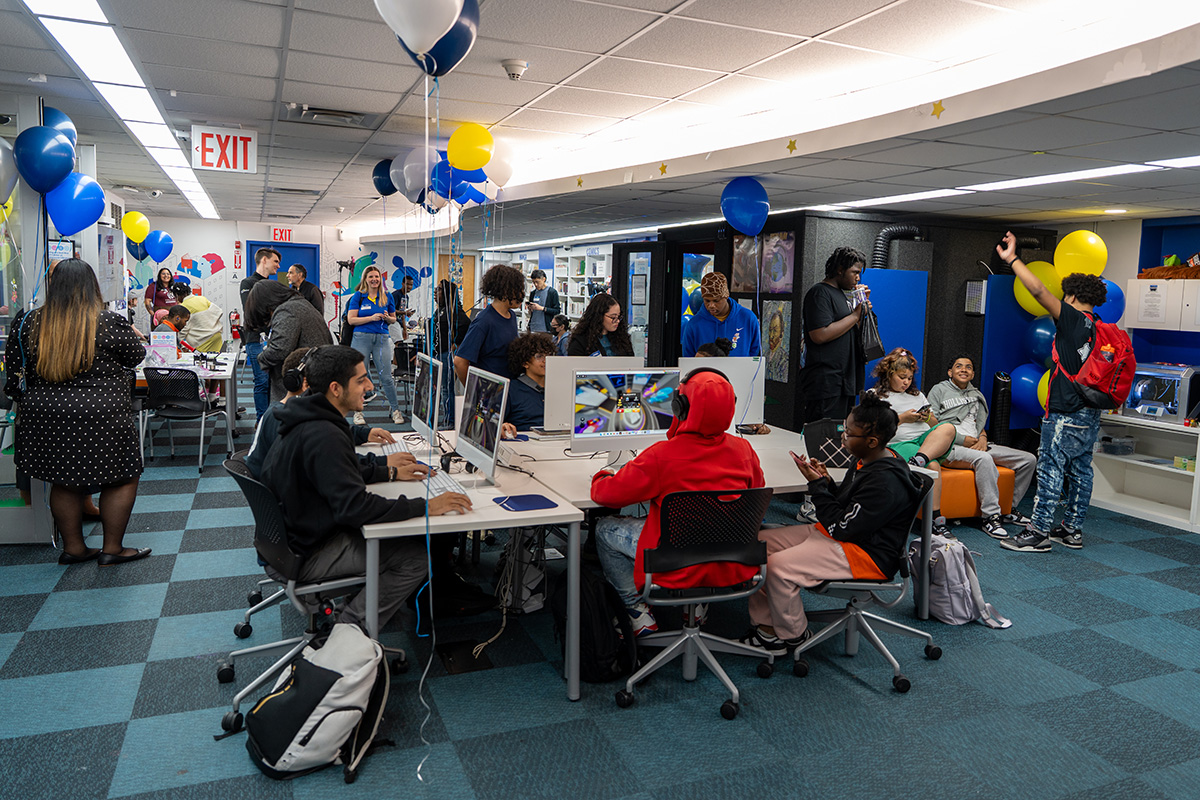
Teens learn tech skills at the New York Public Library’s Grand Concourse Library. Just 14 percent of libraries provide college or trade school preparation programs, according to a Public Library Association survey. (Credit: Jonathan Blanc / New York Public Library)
Jazmin lives in San Diego, where more than 99,000 residents over the age of 25 do not have a high school diploma. She spends her days after school at the San Diego Public Library’s youth program, Discover U, which offers free test prep, college application, and financial literacy workshops with support from a new Carnegie grant. Jazmin is especially worried about the SAT, but the adults at the library “are really nice, and help you talk through it,” she says.
Jennifer Jenkins, San Diego Public Library’s deputy director of customer experience, overseeing the system’s youth services team, says that libraries typically see a dip in usage among teens. In its 2022 survey, the Public Library Association found less than one-third of surveyed libraries offer teen after-school or homework programs, and just 14 percent provide college or trade school preparation programs. “Libraries must be more intentional in order to capture this key population before we lose them altogether,” Jenkins says.
San Diego Public Library makes a special effort to provide holistic assistance to teens from first-generation, low-income, and underrepresented backgrounds. The goal is to help them understand “how to survive in this world when you get out of high school,” says Jenkins, “and how to be successful while you’re doing it.”
Now an incoming high school senior, Jazmin is determined to apply for college for the benefit of her family. “Eventually, when I make enough money, I’ll come back to them and help them,” she says. “I want to buy them a house. That’s the dream.”
Wilfred Chan is the senior content editor and writer at Carnegie Corporation of New York.
Andrew Carnegie believed libraries were an essential resource for people of all backgrounds to seek opportunity and integrate into American society. Learn more about the grantees who were selected as part of the grantmaking initiative Libraries as Pillars of Education and Democracy, a national call for proposals to help libraries deliver critical services like English language learning and college access programs.