The Challenge
School board members, parents, education stakeholders, and all educators have a vested interest in the success of all students. And one thing they have witnessed firsthand is clearly supported by research: curriculum has a direct impact on student engagement and learning. The instructional materials that teachers use with their students can dramatically accelerate or hamper learning.
Perhaps less obvious, yet even more important, is that the way in which teachers use curriculum matters too. This presents a unique opportunity to enhance the efforts of hard-working teachers: provide them with strong, high-quality, standards-aligned curriculum and make sure they know how to take advantage of everything it has to offer. The question is, how?
The Elements and the Essentials
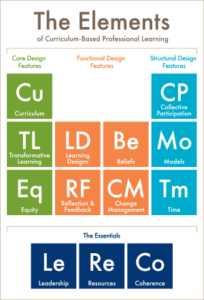
We have identified a core set of actions, approaches, and enabling conditions that effective schools and systems have put in place to reinforce and amplify the power of high-quality curriculum and skillful teaching. We call these the Elements of Curriculum-Based Professional Learning, or simply the Elements.
The Elements encompass actions big and small, from purposefully selecting a strong curriculum to planning efficient teacher meetings wholly focused on instruction. In this paper, we define each of the 10 Elements and show how school and district leaders, curriculum developers, and organizations that support teacher development can apply them in their roles and communities. We also identify foundational conditions that system leaders must establish to ensure that curriculum-based professional learning can thrive. We call these the Essentials.
Taken together, the Elements and the Essentials offer a foundation for practitioners looking to undertake this work. They also serve as a call to action. This powerful approach to curriculum reform and professional learning knits together two influential aspects of a child’s education: teachers’ skillfulness and the quality of the instructional materials they use. By reshaping current practices with the Elements and the Essentials as a guide, we can help teachers develop the skills, knowledge, and understanding they need to set all students up for success.
Elements in Action
Learn more about some of the schools and educational organizations that have made the move to curriculum-based teacher learning.
Curriculum in Action: Charlotte-Mecklenburg Schools
Transformational Learning in Action: Gladstone Elementary School
Equity in Action: Lafayette Parish School System
Learning Designs in Action: Boston Public Schools
Collective Participation in Action: Sunnyside Unified School District
What Is Curriculum-Based Professional Learning?
Curriculum-based professional learning invites teachers to participate in the same sort of rich, inquiry-based learning that new academic standards require. Such learning places the focus squarely on curriculum. It is rooted in ongoing, active experiences that prompt teachers to change their instructional practices, expand their content knowledge, and challenge their beliefs. This stands in contrast to traditional teacher training, which typically relays a static mass of information that teachers selectively apply to existing practice.
Instead of a one-time workshop, facilitators guide a series of focused, small-group sessions that are structured like a typical day’s lesson, allowing teachers to experience the instruction that their students will receive. Working together, teachers rehearse lessons and address common concerns. They deepen their subject knowledge and fine-tune their instructional approaches, growing fluent in the curriculum’s rigorous content and sequence of learning. Over time, both inside and outside their classrooms, teachers see firsthand how their day-to-day choices can enrich or cut short inquiry-based learning. These experiences help reshape their beliefs and assumptions about what their students can achieve.
This vision of professional learning uses curriculum as both a lever and a guide, helping link teachers’ actions and ideas to new standards in a concrete, focused way. Done right, it can close the gap between the experiences we provide for teachers and those we want them to provide for students. Given the challenges teachers and students are currently experiencing as they adapt to remote instructional platforms, such learning is especially crucial to their success.
Six Fundamental Shifts
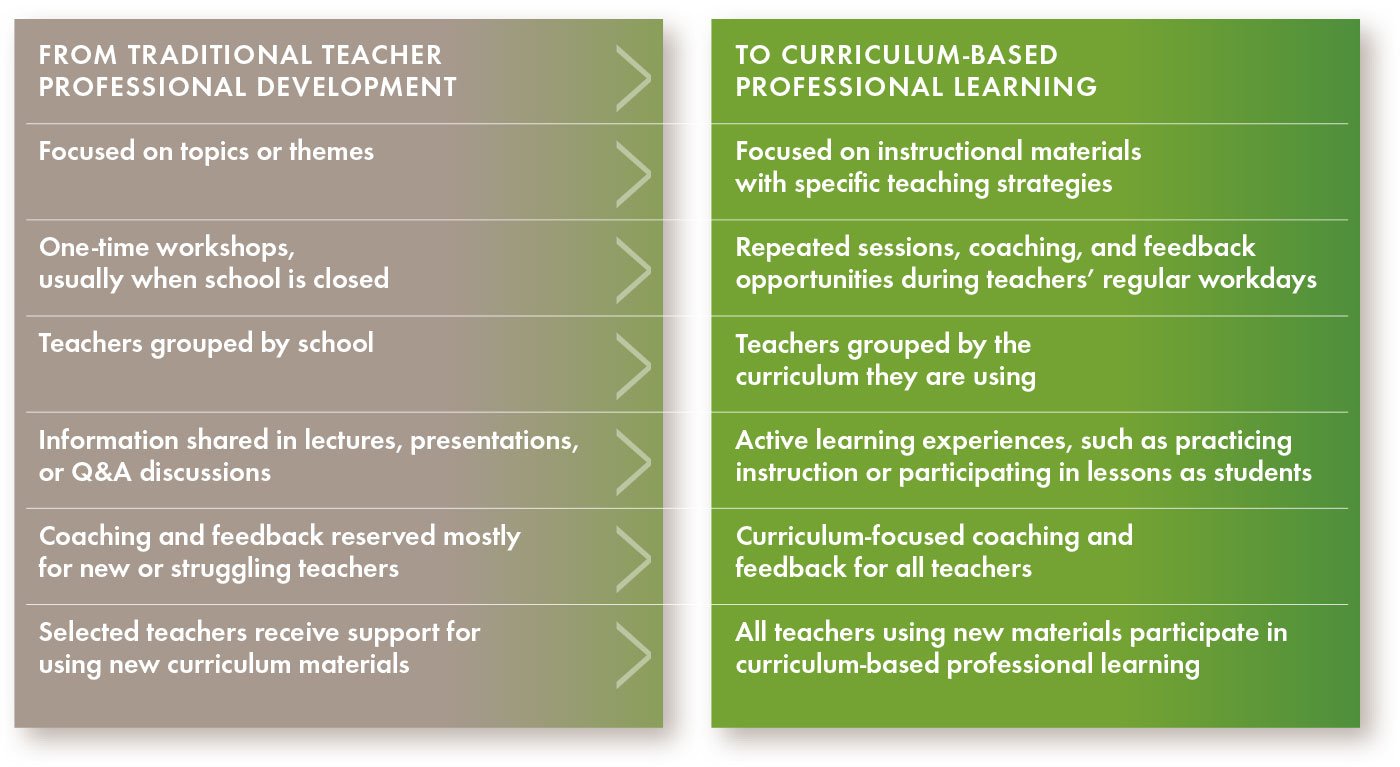
Traditional teacher professional development often takes the form of a lecture-heavy workshop disconnected from the day-to-day lessons that teachers lead. By contrast, curriculum-based professional learning is active, ongoing, and focused on improving the rigor and impact of teachers’ lessons. It calls for six major shifts.



 How can we make professional learning work better for teachers and their students?