
2025 Andrew Carnegie Fellows
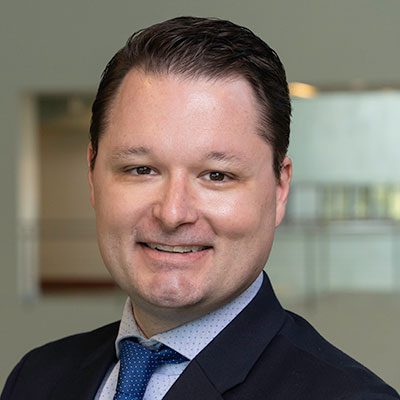
Joshua M. Scacco
Associate Professor, Department of Communication, University of South Florida
Joshua M. Scacco is an associate professor in the department of communication at the University of South Florida (USF). Scacco is also the founding and current director of the Center for Sustainable Democracy at USF. His research is focused on how agents and leaders in a democracy can effectively and ethically harness communication technologies to strengthen democratic governance. This position aligns with his commitment to and experience applying his research through partnerships that extend democratic representation and employ democratically focused approaches for government officials, journalists, and citizens. He is the coauthor of the book The Ubiquitous Presidency: Presidential Communication and Digital Democracy in Tumultuous Times (Oxford University Press, 2021). In addition to publications in communication, journalism, and political science journals, Scacco has applied his research in partnerships with the U.S. Department of State, news outlets and journalism nonprofits, and local governments. His perspectives have been featured in The Washington Post, The Guardian, Politico, national and local podcasts, and local news outlets throughout Florida. Before becoming a university professor, Scacco worked in public relations at the state and federal levels and worked for a member of legislative leadership in the Pennsylvania House of Representatives, as well as a U.S. senator.
Scacco’s project, “Diasporas, Public Health, and Political Polarization,” places public health matters and democratic life in focus to examine information quality challenges associated with polarized public health topics among Hispanic diaspora communities in the United States. Specifically, the project assesses the scope of the content quality challenge as propagated in online spaces; the contours of public opinion regarding false belief uptake in Hispanic diaspora communities, as well as the determinants of such false beliefs; and the community-based solutions that integrate research-based evidence and culturally/politically adapted approaches to mitigate polarization and correct false beliefs.