
13 Barriers to Voting
Here are some of the most common ways voting rights are undermined across the country.
Dec 20, 2019
This article was updated in March 2025.
Legislators in states that have a long track record of voter suppression often implement laws and engage in activities that make it harder for certain segments of the population to vote. Here are some of the most common ways voting rights are undermined across the country.
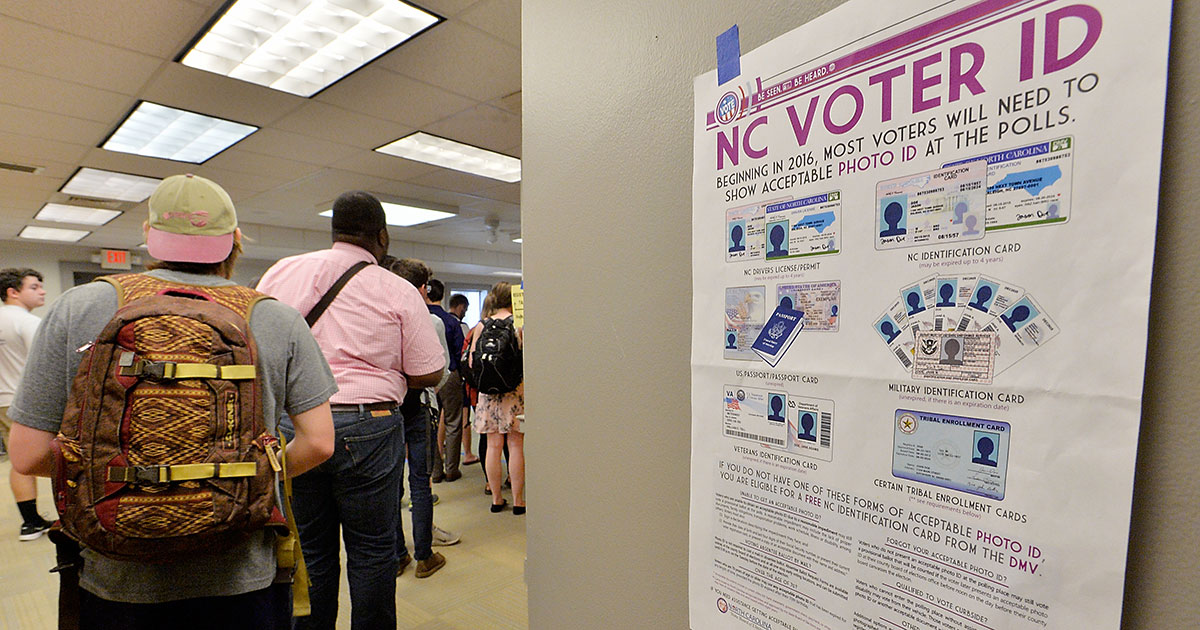
Voter ID requirements. Election officials use false claims of rampant voter fraud to justify strict requirements like a photo ID, often aimed at suppressing the votes of people of color and younger voters. Laws requiring voters to have a physical street address can discriminate against people who are more likely to have P.O. box addresses, including Native Americans living on reservations, college students, and young and low-income residents who move frequently.
Lack of language access. The English-language requirements of the past may be gone, but voting rights groups regularly receive reports that local jurisdictions are not translating materials or offering language assistance as required by law, proving a persistent barrier to increased voting among voters with limited English proficiency.
Voter roll purges. Under the guise of reviewing voter rolls to remove duplicate names, the names of deceased individuals, or those with standing felony convictions, officials have undertaken indiscriminate “purges” of voter lists in recent years, deleting millions of eligible voters’ names, often with a disproportionate impact on communities of color and young people.
Polling place closures/consolidations. Recent analyses have found that election officials have closed thousands of polling places, largely affecting communities of color, low-income voters, and voters with disabilities. Despite the rise of mail-in voting, more than half of voters still voted in person in 2020—a reminder that local governments still need to have polling places open in places that make it convenient for all residents to vote. A March 2024 report indicated that the number of polling places nationwide dropped by 100,000 between the 2018 and 2022 elections.
Lack of funding for elections. A lack of funding inhibits the ability of localities to manage elections in ways that assure open access to voting for all eligible residents. A recurring problem: equipment and staffing shortages that result in long lines to vote, especially in communities of color and low-income communities. A New York Times analysis found that voters in nonwhite neighborhoods were more likely than those in white neighborhoods to experience long voting lines during the 2020 election.
Provisional ballot requirements. Federal law allows voters whose eligibility is in question to use a provisional ballot to be counted once the voter is confirmed eligible. However, localities set their own rules regarding how many provisional ballots to print and training poll workers on processing them, resulting in eligible voters being turned away or their ballots discounted.
Reduced early voting. States and localities have long used early voting to reduce the Election Day crunch and open up the process to prospective voters bound by work or other commitments. Faith-based groups have also used early voting for nonpartisan get-out-the-vote efforts. Recently, officials across the nation have curtailed early voting, largely affecting voting opportunities for communities of color.
Reduced voting hours. Like limiting early voting, reducing voting hours can make voting less convenient, and even impossible, for many voters. Low-income and working-class people often have less freedom to arrive late or leave early from work, or to take a break from their shifts in the middle of the day. Parents with inflexible childcare arrangements can be similarly impacted.
Poorly trained poll workers. Poll workers need good training to follow the right policies like properly checking IDs, giving language assistance, identifying voter intimidation, and offering provisional ballots. Yet a lack of funding, coupled with a lack of commitment to making voting welcoming and convenient, means poll workers are poorly equipped to do their jobs.
Partisan election administrators. Our country’s highly decentralized election system hands responsibility for managing elections to state and local administrators, some of them partisan officials with a clear interest in election outcomes favorable to their parties and candidates. Too often, this results in efforts to suppress the votes of groups that might be viewed as opponents.
Lack of information. Many voters lack reliable information about elections, issues, and candidates. People who aren’t registered to vote, or don’t vote on a regular basis, may be overlooked by campaigns that focus on turning out reliable “base” voters. The decline of local media and limited government funding for elections has also made it harder for voters to find nonpartisan information about elections.
Intimidation of voters and election officials. Recent elections have been marked by an increase in threats targeted at voters and election officials, reducing the ability of local jurisdictions to hire election officials and making voters more reluctant to go to the polls. Recent surveys also show significant numbers of election officials expressing concern about their safety, as well as expressing a desire to leave their jobs.
Lack of investment in civic education. The United States invests just 5 cents in civic education for every 50 dollars that goes to education in science, technology, engineering, and math (STEM) subjects. Advocates say the lack of investment in civics means students come of age without a full understanding or appreciation of American democracy and the transformative power of voting and civic engagement.