What You Need to Know About Redistricting
Your district might have changed since the last election. Here is why
By Matt Schiavenza
Oct 28, 2026
When Missouri residents head to the polls to vote in midterm elections next month, some will be in different districts than when they voted in the primary just three months earlier. How is this possible?
In 2022, as part of routine once-a-decade redistricting, Missouri lawmakers approved a congressional map. It featured six Republican-dominated districts and two Democratic-dominated ones. But in 2025, the Missouri legislature passed a new map that eliminated one of the Democratic-led districts, held by Kansas City–area representative Emanuel Cleaver.
When Missourians voted in their primary elections in August, the map drawn in 2025 was used. However, a grassroots organization called People Not Politicians gathered enough signatures to place a referendum on November’s ballot to overturn the 2025 map, a move that, according to the Missouri Supreme Court, suspended the attempted redistricting. On three separate occasions the U.S. Supreme Court, most recently on September 25, left the Missouri court’s ruling in place.
The districting changes in Missouri illustrate how the redrawing of congressional lines has become a flashpoint in the increasingly polarized United States. A survey conducted in December 2025 and January 2026 by the Center for Transparent and Trusted Elections at the University of California San Diego revealed that just 27 percent of Democrats, 21 percent of independents, and 35 percent of Republicans trust that district lines are arranged in ways that fairly reflect what voters want. And a recent Gallup and Kettering Foundation poll found that 77 percent of Americans expressed concern about the practice of gerrymandering, which refers to the drawing of district lines to maximize political advantage.
“Voters should choose their leaders, not the other way around,” said Raymond Partolan, voting rights program officer at the State Infrastructure Fund, a Carnegie grantee that has done extensive work to ensure election integrity. “But we’re seeing people change the rules, using redistricting as a tool to secure power.”
Learn more about redistricting, gerrymandering, and how to confirm your district in the next election.
What are redistricting and gerrymandering?
Redistricting refers to the periodic redrawing of electoral districts to reflect updated population data, which is provided by the constitutionally mandated census conducted once every 10 years. Forty-four states have multiple congressional seats; the other six have only one at-large district covering the entire state. States conduct redistricting in multiple ways: some through their legislatures, some through independent commissions, and some through a hybrid of the two. Today, mapmakers use software that can draw lines with surgical precision. Redistricting occurs at every level of American democracy and shapes jurisdictions for everything from the U.S. Congress to local school boards.
Gerrymandering typically relies on two techniques: “packing” voters of one political party into a single district and “cracking” them into multiple districts so that the power of their vote is diluted.
“Voters should choose their leaders, not the other way around. But we’re seeing people change the rules, using redistricting as a tool to secure power.”
Raymond Partolan
Voting Rights Program Officer, State Infrastructure Fund
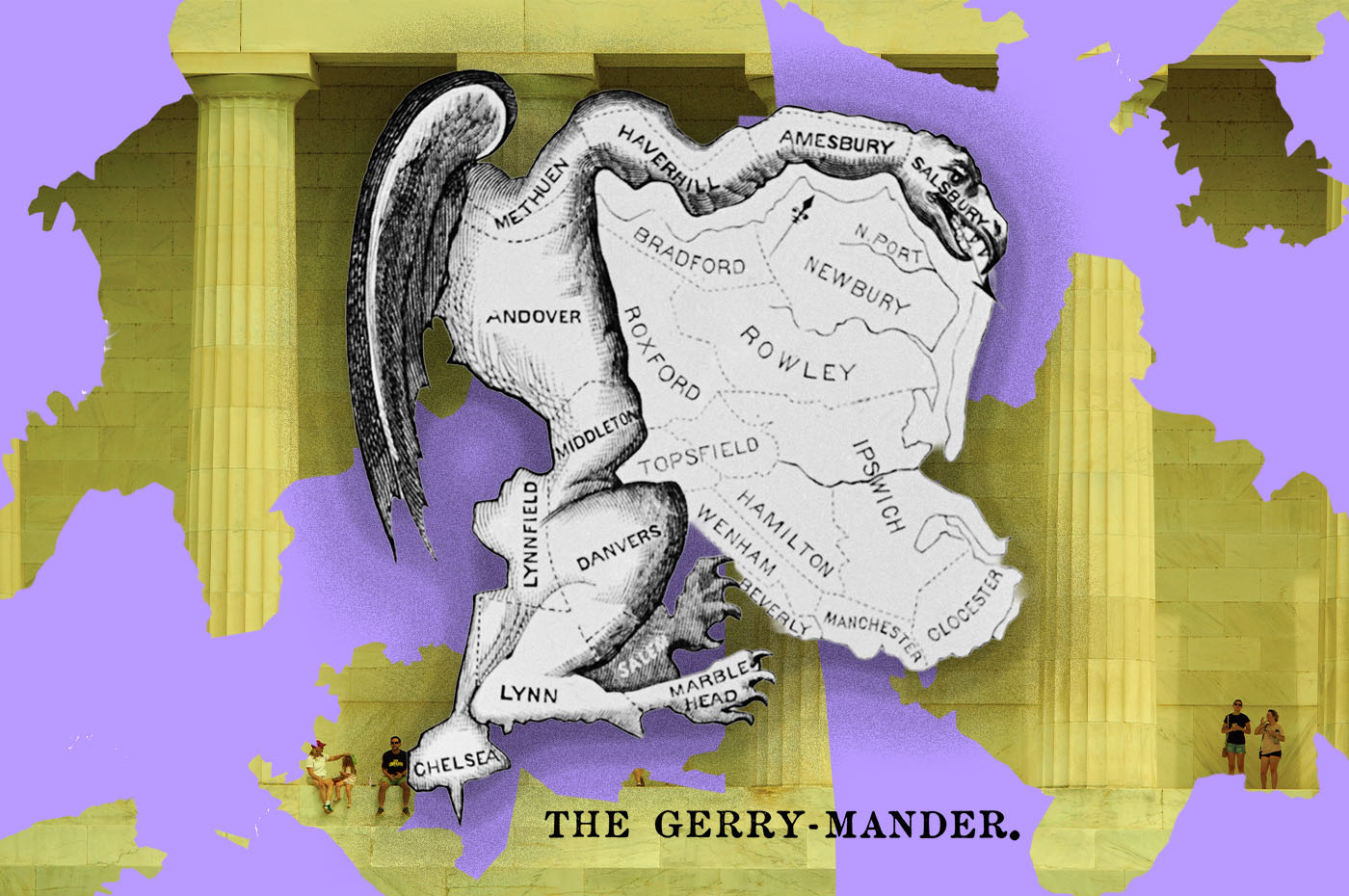
The term dates to 1812, when Governor Elbridge Gerry signed a bill creating a state senate district in the shape of an amphibian to preserve the power of his Democratic-Republican Party in Massachusetts. In covering the controversy, The Boston Gazette coined “gerrymander” by combining the governor’s name and “salamander.” Throughout the 19th century, American politics featured numerous redistricting fights, but by the 20th century, the bigger problem was that states changed their maps too infrequently. Louisiana, for example, then dominated by the Democratic Party, chose not to change its congressional districts at all between 1912 and 1966. Rather than consolidate power for a political party, midcentury redistricting more often worked to protect incumbent representatives.
How did reforms in the 1960s change redistricting?
By the mid-20th century, the United States experienced rapid demographic change, as millions of rural Americans moved into cities, and many states, having failed to redraw their maps, were left with districts of widely unequal populations. Three Supreme Court decisions issued in the early 1960s modernized redistricting and set the stage for fights decades later.
In Baker v. Carr (1962), the Court ruled that challenges to legislative apportionment were “justiciable,” meaning that federal courts could hear them. Wesberry v. Sanders (1964) applied the “one person, one vote” principle by requiring that congressional districts be as nearly equal to each other in population as possible. And Reynolds v. Sims, also issued in 1964, mandated that both chambers of a state legislature, including state senates, be apportioned by population, unlike the U.S. Senate.
In 1965, Congress passed the Voting Rights Act, a signature piece of civil rights legislation that outlawed racially discriminatory voting practices and suspended literacy tests in states with histories of discrimination. Section 2 of the act barred voting practices that discriminate on the basis of race, a provision courts later applied to maps that dilute minority votes, while Section 5 required jurisdictions with a history of racial discrimination to “preclear” their voting rules, including maps, with federal authorities before they took effect. For the rest of the century, redistricting proceeded on a predictable once-a-decade cadence.
How has redistricting changed in recent years?
By the early 21st century, as political polarization in the United States increased, redistricting once again became fiercely contested.
In 2006, ruling on Texas’s 2003 mid-decade redraw of its congressional map, the Supreme Court held in LULAC v. Perry, a case involving the League of United Latin American Citizens, that federal law did not prohibit mid-decade redistricting. This set the stage for the redraws now underway in multiple states.
Other decisions eroded the protections of the Voting Rights Act or narrowed federal oversight of redistricting. Shelby County v. Holder (2013) effectively ended preclearance, meaning that states with a history of racial discrimination no longer need approval from the federal government to redraw their maps. Rucho v. Common Cause (2019) ruled that the federal courts cannot hear partisan gerrymandering claims, though they can still review claims of racial gerrymandering. Finally, Louisiana v. Callais (2026) ruled that Section 2 of the Voting Rights Act imposes liability only when the evidence supports a strong inference of intentional discrimination, not simply when a map has a discriminatory effect. Allen v. Milligan, decided in 2023, had briefly bucked this trend, but Callais largely undercut it.
The result? Redistricting now operates very differently than it did even 30 years ago. In many states, lawmakers can redraw congressional districts whenever they wish to achieve maximum political advantage with little risk of federal judicial intervention over partisan motives. Even states that have established independent commissions for creating fair, nonpartisan maps are not immune to these changes. In 2025, after Texas redrew its map to shift five additional seats toward the Republican Party, California voters passed a ballot initiative suspending the state’s independent commission in order to create five new Democratic seats. Multiple other states, including Florida, North Carolina, and Ohio, engaged in similar efforts, with varying degrees of success.
What redistricting reforms have been proposed?
The Brennan Center has advocated for the John R. Lewis Voting Rights Advancement Act, which would reestablish preclearance following Shelby County v. Holder.
Members of Congress have also introduced other bills to curb gerrymandering. In 2019 and again in 2021, House Democrats passed the For the People Act, which would have required states to use independent redistricting commissions, but the bill died in the Senate. The Fair Representation Act, introduced by Representative Don Beyer of Virginia on five separate occasions, would allow the United States to switch from single-member congressional districts to a system of proportional representation, which supporters say would make room for more than two viable parties. The act has yet to pass either chamber of Congress.
Despite the precision with which mapmakers design congressional districts, one variable remains outside of their control: shifting political sentiment. Groups of voters that reliably support one party are not guaranteed to continue doing so, and abrupt changes can cause gerrymandering attempts to backfire.
“I think a lot of people will look back on the effort to redraw maps in the middle of a decade as foolhardy,” said Kareem Crayton, vice president of the Brennan Center’s Washington, D.C., office. Mapmakers, he noted, are relying on census counts more than five years old at a time when many voters are switching allegiances. “It’s always a bet, particularly when the public is in flux.”
Matt Schiavenza is the senior content editor and writer at the Andrew Carnegie Foundation.